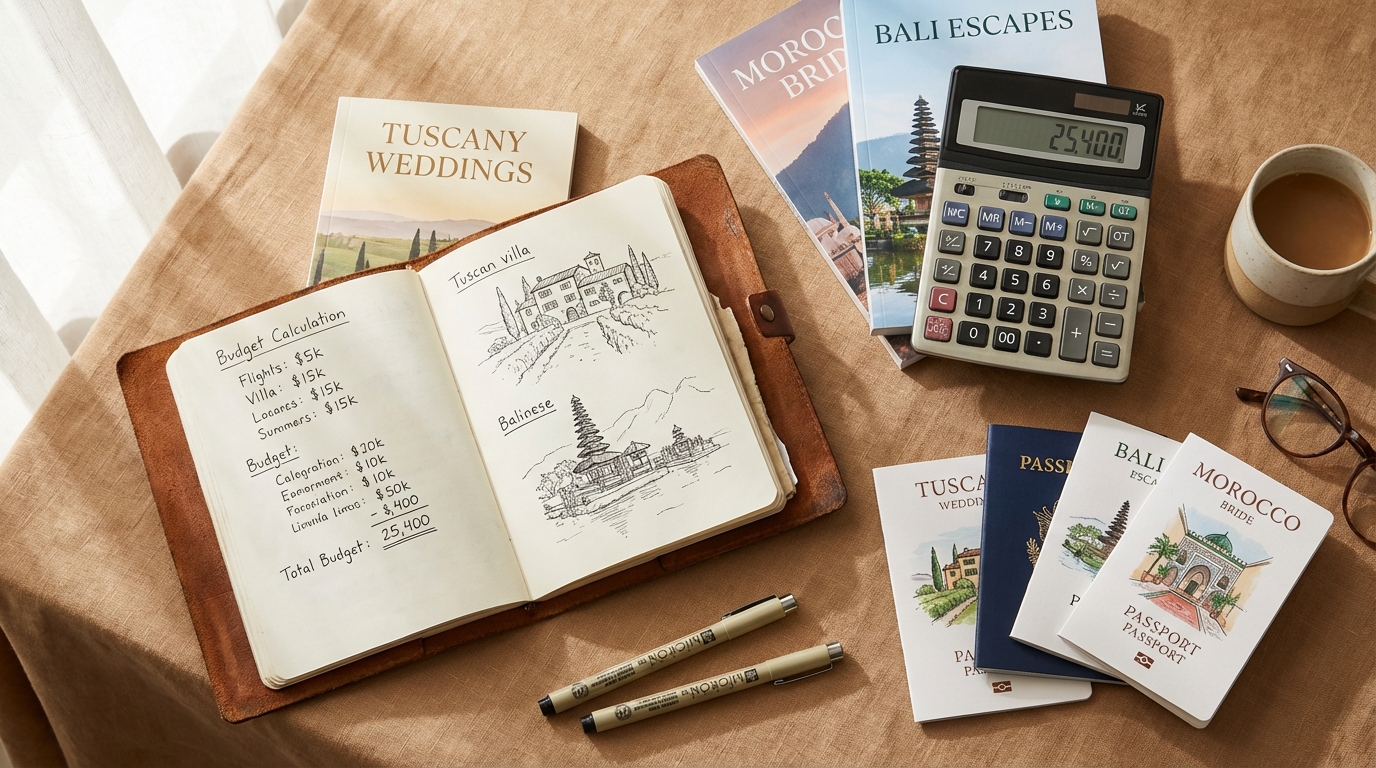
Here’s the math that most couples miss before they start planning: The Knot’s Real Weddings Study puts the national wedding average above $30,000 and rising: a 150-guest local wedding at a traditional venue costs $45,000-$65,000. A 40-guest destination wedding in Cancun at an all-inclusive resort costs $20,000-$30,000. Same couple. A fraction of the guests. A more memorable experience. And $20,000 to $35,000 more in your pocket: or your honeymoon fund.
Destination weddings are not inherently expensive. They’re often cheaper. But only if you make smart decisions about when, where, and how you structure them.
Here are 10 specific strategies that work.
Can booking shoulder season save $8,000-$15,000 on venue and accommodation?
Yes: every popular destination prices peak and shoulder windows very differently, and the gap runs 25-40% on venue packages and room blocks. No other single decision affects more of your total budget.
This is the single most impactful lever available to you. Every destination has a peak season (when everyone wants to go) and a shoulder season (when pricing drops dramatically because venues have availability they need to fill).
Mexico and Caribbean: Peak season is mid-December through March: Christmas and spring break are the priciest weeks. Shoulder season is May through mid-June and mid-October through early November. Resorts and venue packages run 25-40% less during shoulder season. A package priced at $20,000 in February might be $13,000-$15,000 in late October. Room blocks for your guests also cost less, which affects how affordable attendance is for the people you want there.
Santorini and Greek islands: July and August are peak season with premium pricing and fully booked venues. April-May and September-October offer the same weather (warm, nearly zero rain) at 20-35% lower venue pricing. October in Santorini is genuinely beautiful: harvest season, soft golden light, fewer tourists on clifftop sunset photos.
Hawaii: Prices are highest mid-December through March and mid-June through August. April-May and September-October are the sweet spots. Weather in Hawaii is good year-round; you’re not sacrificing conditions by avoiding peak.
Bali: Avoid July-August (peak season). May-June and September-October are equally beautiful at meaningfully lower cost. December-March has a rainy season: usable but plan a covered contingency.
The guest accommodation piece multiplies the savings: if 30 guests each save $200-$400 on room rates by attending in shoulder season, that’s $6,000-$12,000 less collectively that your guests need to spend to attend. More guests can say yes. Everyone benefits.
How do room block commitments unlock venue discounts that aren’t listed anywhere?
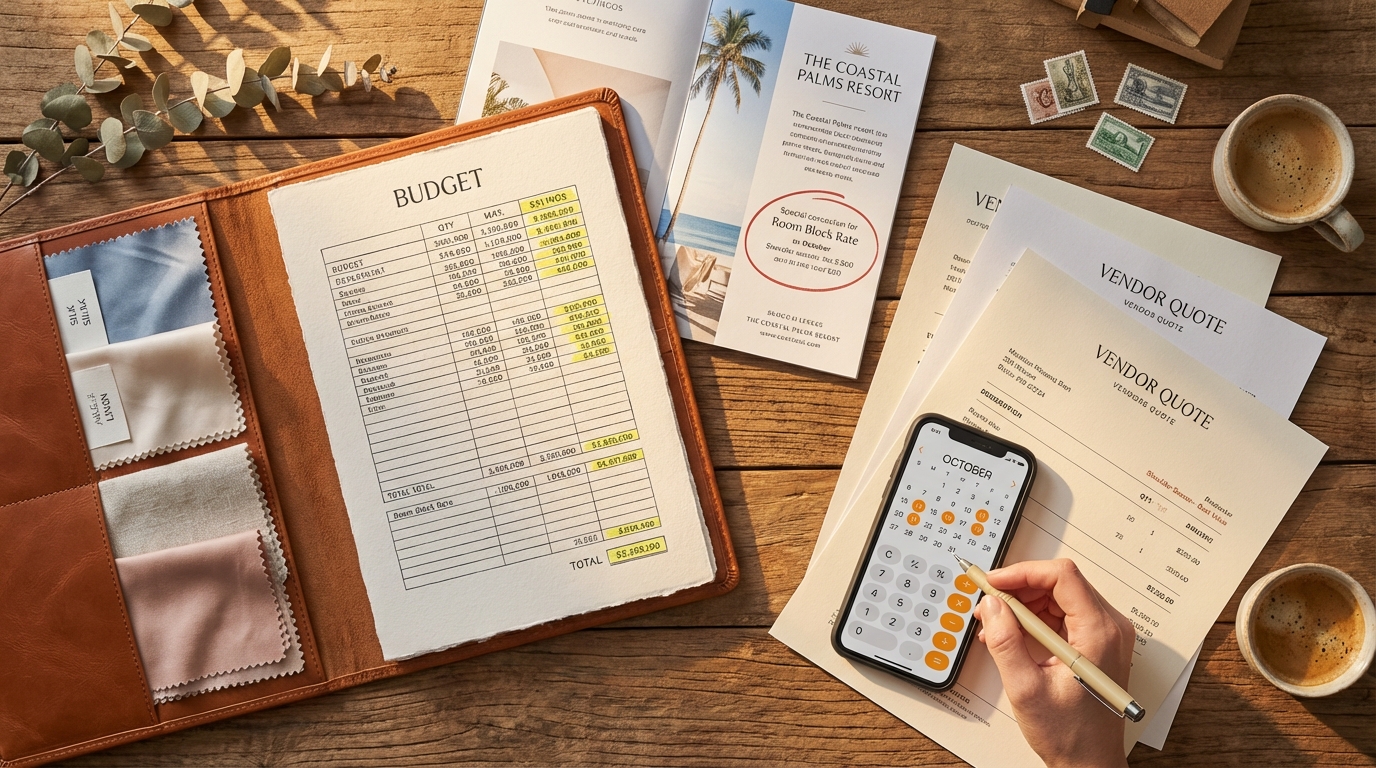
Committing 10-20 rooms for 3-5 nights represents $20,000-$60,000 in guaranteed room revenue. That gives you real negotiating power: resorts can waive ceremony fees, reduce F&B minimums, and comp upgrades in ways that never appear in the standard brochure.
When you commit to a room block: typically a minimum of 10-20 rooms for 3-5 nights: resorts and hotel venues will negotiate. This is one of the most underused negotiating points in destination wedding planning, and it can unlock significant discounts that aren’t advertised.
Here’s how it works: a 20-room block committed for 4 nights represents $20,000-$60,000 in room revenue depending on the property. That’s real money. Resort sales managers have latitude to negotiate venue fees, comp upgrades, include ceremony setups, or reduce food and beverage minimums when they know a room block is coming with the wedding.
Specific things you can often negotiate: a reduced or waived ceremony venue fee (saves $2,000-$5,000), complimentary room upgrades for the couple, reduced F&B minimums, included welcome dinner or cocktail reception, or complimentary day-after brunch. You won’t get these if you just book individual rooms: you only get them if you formally commit a room block and negotiate before signing.
Ask your planner or resort coordinator specifically: “What can you include if we commit to a 20-room block for 4 nights?” and make the negotiation explicit.
What do all-inclusive elopement packages actually include at destination resorts?
Most major resort destinations offer ceremony packages for 10-20 guests in the $3,000-$8,000 range, covering setup, officiant, cake, champagne toast, and often a photographer for two hours. These aren’t stripped-down: they’re well-designed packages built around the intimate destination format.
If you’re willing to limit your guest list to 10-20 people, resort elopement packages are genuinely extraordinary value. Most major resort destinations in Mexico, the Caribbean, and Hawaii offer ceremony packages in this range that include:
- Ceremony setup (arch, chairs, florals)
- Officiant
- Wedding cake
- Champagne toast
- A room-upgrade or complimentary night
- Sometimes a photographer for 2 hours
At Sandals resorts in Jamaica or the Bahamas, elopement packages start around $3,000-$4,000. Moon Palace in Cancun has micro-wedding packages starting at $5,000 for 20 guests. Excellence Playa Mujeres packages start around $8,000. These aren’t stripped-down experiences: they’re well-designed packages that provide a genuinely beautiful wedding at a fraction of the traditional cost.
The tradeoff is real: you’re inviting 15 people instead of 80. That is a hard conversation with some families. But the couples who’ve done it almost universally say the intimacy made it better: not just cheaper.
Why are destination-based vendors usually better value than flying your home vendors in?
Flying in your home photographer adds $2,000-$5,000 in travel costs alone: airfare, hotel, travel day fee, and per diem. Destination photographers based at your venue have also shot it dozens of times and know exactly where the best light falls at every hour.
This one trips up couples who have already been working with a photographer or planner at home and want to bring them to the destination. The instinct is understandable, but the cost is significant.
Flying in your home city photographer adds: roundtrip airfare ($600-$1,500), 2-3 nights hotel ($200-$600/night), a travel day fee that most photographers charge ($300-$1,000), and often a per diem for meals and incidentals. You’re looking at $2,000-$5,000 in travel costs on top of their base rate.
Destination wedding photographers who are based in your destination are just as talented: often more so, because they know the specific lighting conditions at your venue, the best locations for portraits, and the logistics of the local wedding scene. They’ve photographed your venue 30 times. Your home city photographer has never seen it.
The same logic applies to planners, florists, officiants, and DJs. The local vendor ecosystem at any major destination wedding market is well-developed. Your destination wedding planner can refer you to local vendors they trust.
Exception: if your home photographer is truly exceptional and has built your entire vision around working with them, the premium might be worth it to you. Just price it honestly.
How much cheaper is a Thursday or Sunday ceremony than Saturday at the same venue?
A venue priced at $10,000 on Saturday typically runs $6,000-$7,500 on Thursday or Sunday: the same space, same package, 25-40% less. Mid-week pricing almost never appears in brochures; you have to ask for it directly.
Saturday is the most expensive day to get married, almost everywhere. Venues charge a premium because Saturday demand is high: they could fill that date with anyone.
Thursday and Sunday ceremonies at the same venue, same package, often run 25-40% less. For a venue that charges $10,000 on Saturday, a Thursday ceremony might be $6,000-$7,500. At resort packages, the savings are often built into the day-of-week pricing tiers.
Logistics for your guests: Thursday means they need to take Friday off work. Sunday means travel home on Monday. Neither is a dealbreaker for a destination wedding where guests are already committed to 4-5 days of travel. For guests who are flying internationally anyway, the day of the week matters less than it would for a local wedding.
Ask specifically about mid-week pricing when you’re comparing venues. It’s often not advertised: you have to ask.
Is buffet service actually lower quality than plated dinner at a beach wedding reception?
No: at the same caterer and ingredient level, buffet saves $30-$60 per person ($1,500-$3,000 for 50 guests) with no meaningful quality loss. At beach weddings specifically, buffet style encourages mingling rather than quiet seated formality.
At the same quality level: same caterer, same ingredients, same venue: a buffet service costs $30-$60 less per person than plated dinner service. For 50 guests, that’s $1,500-$3,000 in savings without any reduction in food quality.
The perception that buffets are lower quality is an indoor American wedding convention that doesn’t apply to destination beach weddings. A lush tropical buffet with a carving station, ceviche bar, local specialties, and multiple salad and side options looks and feels abundant and celebratory. It encourages mingling. Guests eat what they want.
Many couples find that buffet service actually improves the party: plated dinner requires everyone to sit quietly while courses come out, which creates a more formal and subdued atmosphere than most beach weddings aim for.
The savings are real. The quality loss is minimal to none.
Which florals cost least at tropical destinations, and which carry import premiums?
Native tropical flowers: orchids, anthuriums, heliconia, birds of paradise: are priced at local growing cost. Peonies, garden roses, and ranunculus imported from temperate regions add shipping and import fees to every stem. Ask your florist what’s in season locally before building any order.
At any destination, the most expensive florals are the ones that had to be imported from somewhere else. In Cancun, peonies and garden roses come from Ecuador or Colombia and arrive with import costs added. Tropical florals: anthurium, orchids, heliconia, birds of paradise, tropical greenery: grow locally and cost less.
More importantly for a beach wedding: native tropical florals are the right aesthetic choice anyway. A bouquet of local flowers photographs beautifully in their natural environment. Imported peonies competing with tropical sunshine look slightly wrong.
When building your floral budget with your local florist, ask: “What’s in season locally and what would have to be imported?” Then build your choices around local availability. This can save $300-$800 on florals depending on your overall arrangement scope.
Why does a smaller guest list produce a more luxurious wedding at the same total budget?
A $30,000 budget at 25 guests is $1,200 per person: at 100 guests it’s $300. The per-person experience: food quality, bar generosity, time with the couple: scales directly with per-head budget. The intimate version consistently wins on feel.
Counterintuitive but consistently true: the luxury feeling at a wedding comes from per-person experience quality, not from total guest count.
A 25-guest dinner with premium stations, a raw bar, personalized welcome bags, upgraded floral, and a private villa venue costs less in total than a 100-guest ballroom wedding: and every guest has a more personal, memorable experience. Your bar never runs low because there are 25 people drinking rather than 100. The food is genuinely good because you’re not feeding a ballroom. You have time to actually talk to every single person.
The math: $30,000 divided by 25 guests = $1,200/guest budget. $30,000 divided by 100 guests = $300/guest budget. The intimate wedding at $1,200/guest will feel significantly more luxurious than the large wedding at $300/guest, even at the same total cost.
This is the destination wedding superpower: the travel barrier self-selects a smaller guest list. The people who come are the people who genuinely want to be there. That self-selection produces a better wedding without any additional effort.
Are all-inclusive resort wedding packages cheaper than booking each vendor separately?
Usually yes: packages price their inclusions at internal cost, not retail. If a package bundles $10,000 in components (photographer, florals, venue fee, cake) and charges $8,000, you’re receiving $2,000 in built-in value. Itemize and price each component independently before deciding.
Most couples see an all-inclusive resort package price and assume they could build the same wedding cheaper by booking components individually. Usually they can’t, and here’s why: resort packages are priced to fill their own vendors. When they include florals, photography, catering, and a coordinator in the package, they’re pricing those inclusions at their internal cost rather than at full retail.
A package that includes a $2,000 cake, $3,000 florals, 3-hour photographer at $2,000, and a venue fee of $3,000: those are $10,000 in components. If the package is listed at $8,000, you’re getting $2,000 in value by using the package. The individual vendors booked à la carte will almost always total more.
The catch: resort package vendors are often (not always) lower tier than the best local independent vendors. Your choice is between convenience and guaranteed coordination at an inclusive price, versus more personalized service at potentially higher cost. Neither is universally correct: it depends on how much the vendor quality matters to you versus the simplicity and price protection.
At minimum: itemize what the package includes and price each component individually before deciding. The math usually favors the package unless you have strong vendor preferences.
How can venue scouting save money and improve your actual honeymoon at the same time?
Resorts regularly comp or deeply discount stays for serious wedding couples doing site visits. A $3,000-$5,000 scouting trip becomes near-free when the resort wants your business, and you’ll know the destination far better when you return for the honeymoon.
This is a practical and (for self-employed couples) potentially tax-advantaged move: visit your destination to scout venues 12-18 months before the wedding, and turn that trip into an exploratory mini-honeymoon.
The business logic: you need to see the venue in person before committing. Most resorts will comp or significantly discount a site visit stay for serious wedding couples: ask your planner or the resort’s wedding sales team directly. Some provide complimentary nights for couples who sign. This converts what would be a $3,000-$5,000 scouting trip into a much lower-cost or free trip.
Combined with actual honeymoon planning: you’ll already know the destination, the hotels, the restaurants, the activity providers: you’re making the honeymoon planning more efficient. Couples who’ve visited before their honeymoon consistently say the trip is better because they’re not discovering; they’re returning somewhere they loved.
For self-employed couples, consult your accountant: a business trip with a primary business purpose (venue selection for your wedding if you’re in the wedding industry, or more broadly if you can make a legitimate case) may be partially deductible. This isn’t advice: consult a tax professional: but it’s worth asking about.
Which wedding categories are worth splurging on, and which can you safely cut?
Splurge on photography: it’s the only element you’ll interact with every year afterward. Save on music (DJ over live band saves $2,000-$5,000), florals (statement ceremony arch, simpler reception centerpieces), and favors (most guests leave them behind).
| Category | Splurge | Save | Typical savings |
|---|---|---|---|
| Photography | Yes: this is all you have afterward | On videography if budget is tight | $1,000-$3,000 |
| Florals | Statement ceremony arch | Reception table arrangements | $500-$2,000 |
| Food and beverage | Bar quality and service | Buffet over plated, fewer courses | $1,500-$4,000 |
| Music | Live ceremony musician | DJ over live band at reception | $2,000-$5,000 |
| Venue | One signature venue, ceremony only | Reuse venue for ceremony + reception | $2,000-$5,000 |
| Stationery | Beautiful save-the-date design | Digital day-of programs | $200-$600 |
| Transportation | Vintage car for couple only | Shuttle for guests instead of private cars | $500-$1,500 |
| Favors | Meaningful, local, small | Skip altogether: guests won’t remember | $200-$800 |
The full cost breakdown by destination is in our destination wedding cost guide. For a complete planning checklist from engagement to wedding day, see the destination wedding guide.
If you’re ready to start getting real quotes, take our matching quiz: you’ll tell us your destination, guest count, and budget, and we’ll connect you with local planners who can give you specific numbers for your wedding.