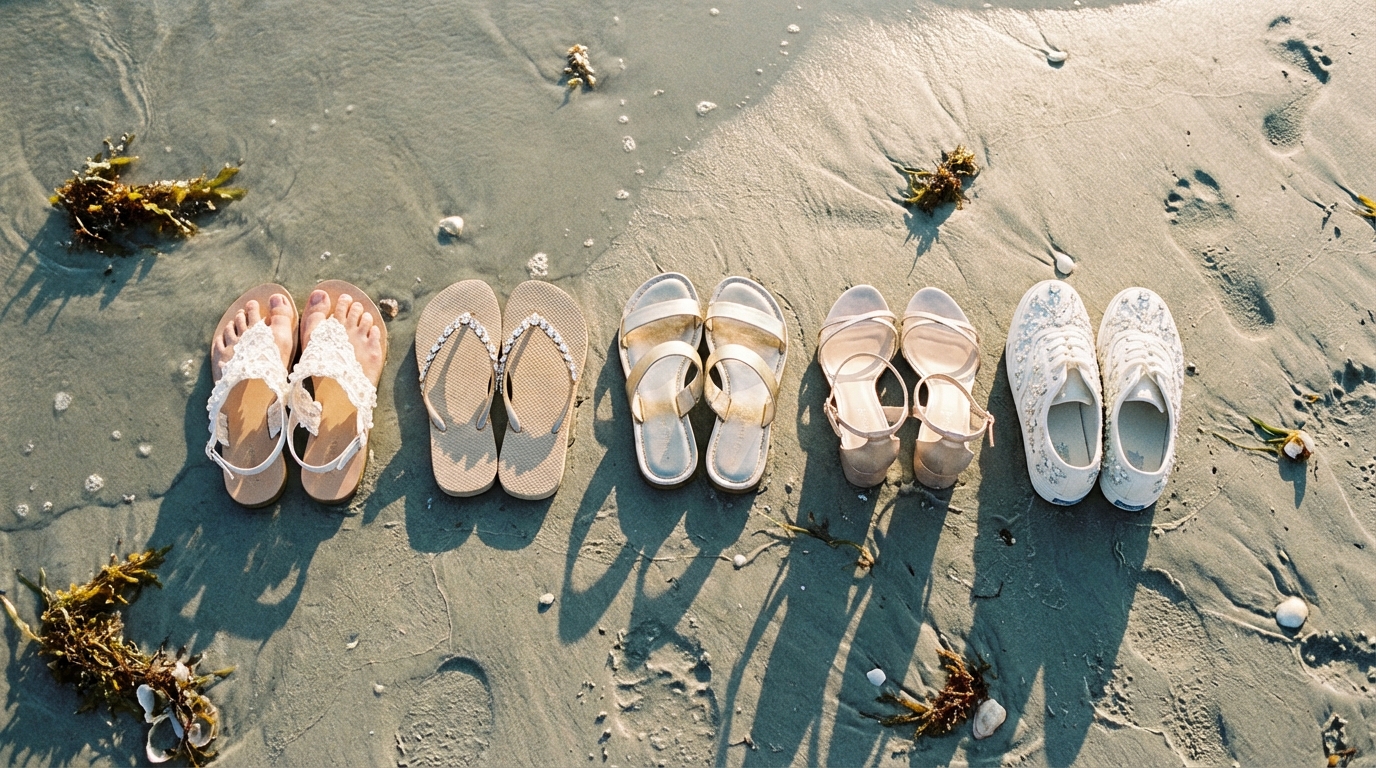
The choice of shoes for a beach ceremony is more consequential than it sounds, because the wrong shoes don’t just look bad: they affect how you walk, how you feel, and whether the first steps of your marriage are graceful or a comedy of sinking heels and panicked hobbling.
The right choice depends almost entirely on one thing: your specific beach surface. That’s not a caveat: it’s the whole framework.
Why does the specific beach surface matter so much?
Different beach surfaces have completely different physical properties, and what works on one will fail on another.
Fine dry sand (think Tulum’s white powder beaches, Caribbean resort beach areas away from the water) collapses under any concentrated pressure. A thin heel literally sinks: not just tips, but disappears. Even a kitten heel will require conscious effort to walk with each step. Flat sandals, wedges with a wide base, or bare feet are the practical options here.
Wet packed sand near the shore is dramatically more stable than dry sand. The water tension compacts the sand particles, creating a surface almost as firm as packed dirt. Kitten heels and block heels become genuinely viable on wet sand. Many couples don’t realize this: they assume sand is sand: but ceremony venues are often set back from the waterline, while post-ceremony photos happen closer to the water where the sand is different.
Hot summer sand is a hazard that has nothing to do with shoes and everything to do with timing. Sand on a full-sun beach on a July afternoon in the Caribbean or Florida can reach 140-160°F at the surface: well above the threshold for burns. Bare feet at a 2pm summer ceremony on unshaded sand is not comfortable. Early morning, late afternoon, or shaded beach areas change this calculus entirely.
Shell beaches and rocky beaches are a completely different category. Sanibel Island in Florida has extensive shell beaches; many Hawaiian beaches have coral or volcanic rock rather than fine sand. Any beach that isn’t fine sand requires shoe coverage for comfort and safety. A rocky or shell-strewn beach in flat sandals with a hard sole is tolerable; barefoot is not.
Boardwalk and platform ceremonies are increasingly common at beach venues: a temporary wooden platform laid over sand, or a permanent pier or boardwalk area. On any hard surface, your shoe options are the same as any other venue. Thin heels, block heels, stilettos, all of it. The surface-aware restrictions only apply when you’re actually standing and walking on sand.
Walk your ceremony venue at the same time of day as your ceremony before you commit to any shoe decision. This is 20 minutes of reconnaissance that saves you from making a decision based on how the beach looks at 9am when your ceremony is at 5pm. The American Podiatric Medical Association notes that surface hardness and slope are the primary variables in shoe stability: understanding your specific surface is more useful than any general shoe recommendation.
What are the 5 shoe options, and what are the real trade-offs?
Option 1: Barefoot (or with foot jewelry)
When it works: Soft, clean sand. Shaded beach or late afternoon when sand has cooled. Intimate ceremonies. Venues where you’re not walking long distances between locations.
When it doesn’t: Hot direct sun mid-afternoon. Rocky or shell beaches. Venues where you walk across parking lots or hard surfaces to reach the beach. Any venue where the walking route includes surfaces that are uncomfortable on bare feet.
Barefoot photographs beautifully: there’s an intimacy to it, and a sand-between-the-toes photo is almost universally loved. Foot jewelry (anklets, toe rings) makes the look intentional rather than “forgot shoes.” Paint your toes well in advance (fresh pedicure 2-3 days before so any puffiness subsides) and choose a color that photographs well.
The practical hazards: jellyfish (beach staff should clear the ceremony area, but still), sharp shells, sea glass, and any debris that washes up. Hot sand genuinely burns: test surface temperature with your hand before committing. For photographers: sand sticks to wet feet, and if you’re getting portraits near the water and your feet get wet, you’ll have sandy feet for the rest of the day.
A reasonable middle path: go barefoot for the ceremony itself, where you’re standing in one place, and wear sandals for the processional and walking to reception.
Option 2: Flat sandals and gladiators
The most practical option by a significant margin. A flat sandal works on every beach surface, in every temperature, at every formality level. The range of dress-up is enormous: a beaded leather sandal from Loeffler Randall ($180-$250) photographs as elegantly as any heeled shoe, while a woven straw sandal from Steve Madden ($60-$80) is casual-chic for a barefoot bohemian aesthetic.
The formality spectrum runs from truly casual (flip flop-adjacent, not appropriate for a formal dress) all the way to highly ornamented strappy flat sandals that look as intentional and bridal as any wedge or heel.
What to look for in a flat bridal sandal: A sole with some grip (smooth leather soles on fine sand are slippery), straps that secure around the heel (a backless mule or flip-flop shifts with each step on uneven sand), and a footbed that won’t be uncomfortable after four hours of standing and dancing.
Specific options that work well: BHLDN’s flat sandal range ($80-$160), Loeffler Randall beaded sandals ($175-$250), Anthropologie’s bridal-adjacent sandal section ($60-$120), Steve Madden for a more casual aesthetic ($50-$90). For the reception, Target’s sandal selection at $25-$45 is genuinely comfortable for dancing.
Option 3: Block heels and kitten heels
Viable on the right surface, risky on the wrong one. A block heel (wide, square heel base) distributes weight over a broader area than a stiletto and sinks more slowly in dry sand: but “more slowly” doesn’t mean “not at all.” In dry fine sand, you’ll still need to consciously lift your heel with each step. On wet packed sand or a hard surface, block heels work beautifully.
Kitten heels (very low, 1-1.5 inches) are marginally better than block heels on sand because there’s less heel-to-ground pressure per unit area. They’re also elegant and comfortable, easier to dance in than a full heel, and appropriate for almost any dress length.
The honest advice: if any part of your ceremony involves walking across dry sand for more than 15-20 steps, a block heel or kitten heel will slow your processional and require concentration. If your ceremony is on a platform, boardwalk, or near the water’s edge on packed sand, they’re fine.
Where to shop: Bella Belle for an elevated bridal aesthetic in kitten heels ($200-$350). BHLDN block heel options ($90-$200). Nine West has several practical block heels at $70-$100.
Option 4: Wedge heels
The best compromise between heel height and sand stability. A wedge heel works because the weight is distributed over the entire heel-to-mid-foot area rather than a single point. A 2-inch wedge with a broad platform sinks minimally into dry sand and walks almost like a flat on packed sand.
Wedges also have a side benefit: they’re dramatically more comfortable over a long event day than stilettos. Your calves don’t fatigue the same way. You can dance in them. You can stand for a three-hour cocktail hour in them without misery.
The wedge aesthetic works best with certain dress silhouettes: A-line, boho/flowy fabrics, shorter destination wedding dresses. A structured ballgown with a wedge can look stylistically mismatched. A flowy chiffon destination dress with a strappy wedge looks exactly right.
Espadrille wedges (see Option 5) are the most beach-appropriate version. Plain wedge heels in leather or satin are more formal.
Where to shop: Sam Edelman espadrille wedges ($70-$100, extremely popular for beach weddings), BHLDN wedge sandals ($100-$200), Castañer espadrille wedges ($120-$180), Badgley Mischka embellished wedges ($150-$280).
Option 5: Espadrilles
The most underrated beach bridal shoe. Espadrilles: shoes with a canvas or fabric upper and a rope/jute sole: were literally invented for warm-weather outdoor wear. The sole is textured and grippy on sand. They come in flat and wedge versions. They look intentionally coastal in a way no other shoe does.
Espadrilles read effortlessly appropriate at beach venues: they feel celebratory rather than formal, which suits the casual-luxury register of most beach weddings. They’re also genuinely comfortable for all-day wear.
The concern people have: “Do they look too casual?” The answer depends on your dress. A lace destination wedding dress with an espadrille sandal looks polished and considered. A full cathedral-train ballgown with espadrilles would be odd. For the 80% of beach wedding dresses that are lightweight, boho, or destination-appropriate in style, espadrilles are exactly right.
Canvas espadrilles can absorb sand and get dirty: white canvas is the highest-maintenance. Natural/jute, metallic canvas, or leather espadrilles are more forgiving.
Where to shop: Castañer is the original espadrille brand and makes legitimately beautiful options ($100-$200). SOLUDOS has a strong beach wedding-adjacent range ($80-$150). Sam Edelman’s Clarice espadrille ($70-$90) has been a consistent bestseller for beach weddings for several years.
Shoe comparison table
| Option | Dry sand compatibility | Formality range | Comfort (full day) | Price range | Best for |
|---|---|---|---|---|---|
| Barefoot / foot jewelry | Excellent (if cool) | Casual to romantic | Excellent | $0-$50 (jewelry) | Intimate ceremonies, soft sand, temperate days |
| Flat sandals | Excellent | Casual to elegant | Excellent | $25-$250 | All-day comfort, all surface types |
| Block / kitten heels | Fair (packed sand only) | Elegant to formal | Good | $70-$350 | Platform/boardwalk ceremonies, formal venues |
| Wedge heels | Good | Casual to elegant | Very good | $70-$280 | All-purpose, boho/flowy dresses |
| Espadrilles | Excellent | Casual to smart | Excellent | $70-$200 | Beach-specific aesthetic, any sand type |
What is the two-shoe strategy?
The two-shoe strategy is exactly what it sounds like: a pair of elevated, photogenic shoes for the ceremony and portraits, and a change into comfortable flat sandals for the reception.
It’s not a compromise: it’s the move. Here’s why it works so well: your ceremony shoe appears in roughly 20% of your wedding photos. The shoes you wear at your reception appear in almost none of them, because dancing and candid shots don’t feature footwear. Spending your entire wedding day in uncomfortable shoes to preserve the look in photos that mostly won’t feature those shoes is a poor trade.
Most beach venue receptions have a bag or basket at the entrance where guests can swap to bare feet or flip flops. Keep a pair of sandals in your getting-ready bag and plan the swap after portraits are done.
Budget for both: $100-$200 for ceremony shoes, $25-$50 for comfortable reception sandals. Total is still less than most single-shoe wedding purchases, and you’re more comfortable all night.
The walk-the-aisle-in-advance tip
Before your wedding day, go to your ceremony venue at the same time of day as your actual ceremony. Wear shoes similar to what you’ve selected. Walk the processional path. Pay attention to:
- How your heel (if any) behaves in the sand
- Whether the sand is hot on your feet if you’re going barefoot or in open sandals
- Whether the surface near the arch / aisle runner is different from the surrounding sand
- How your dress interacts with your shoes when you’re walking: some heel heights will cause you to step on a long hemline
This is 10 minutes of the most useful wedding planning you’ll do. Surprises on the processional path are the kind that end up in your wedding memory forever, and not the good kind.
Your shoes are one decision in a longer checklist. If you’re in the early stages of beach wedding planning, our beach wedding checklist covers everything from shoes to permits to seating logistics. Ready to find vendors and venue options? Take the quiz and we’ll match you with planners who work your specific destination.