Your color palette looks one way on a design board and something completely different at 4pm on a white-sand beach in direct Caribbean sun. This isn’t a Pinterest fail situation: it’s just physics.
Beach venues are a different optical environment than any ballroom, barn, or garden. Before you commit to your palette, you need to understand how beach light actually works: and then you can choose colors that look exactly as beautiful in your photos as they do in your imagination.
Why does beach light change how colors look?
Beach light is three distinct phenomena that interact with color in ways indoor venues never produce.
According to color theory research from the Munsell Color Science Laboratory, outdoor light conditions dramatically alter perceived hue, saturation, and value: effects that are amplified at beach venues by reflective surfaces and high UV index.
Midday sun is a bleaching agent. Direct equatorial sun at noon creates exposure conditions where your camera (and your eye) has to choose between preserving highlights and preserving shadow detail. Colors that are already light: pale pink, cream, mint, pale yellow: can blow out completely, losing all their detail and depth. The photo equivalent of overexposing a film negative.
Water and sand reflect and amplify. A white-sand beach doesn’t just sit there. It bounces light upward, filling in shadows from below. This creates a diffused quality that’s actually flattering for portraits but can make cool colors (lavender, slate, cool gray) look flat and colorless. Meanwhile, warm colors: coral, terracotta, gold: absorb and re-emit that bounced light beautifully.
Golden hour at the beach is different from golden hour anywhere else. That 45-60 minute window before sunset produces light that shifts everything warm. Greens go golden. Blues deepen. Coral and warm neutrals practically glow. But lavender turns brownish-gray, and mint turns yellow-green in a way that looks like a photo processing error. If your ceremony is at sunset: the most common beach wedding time: your palette needs to survive this shift.
Shade is a different color temperature altogether. The covered area near your reception tent or a shaded grove reads with a blue-green cast. Bright white goes gray. Soft pink goes gray-purple. Warm tones and deep saturated colors hold up best when the light source isn’t direct sun.
Does the season or destination affect which colors work?
Yes, significantly. Winter Caribbean light and summer Pacific afternoon light are not the same beast.
Caribbean and Mexico, November through April: lower sun angle, softer contrast, slightly more golden quality even at midday. Excellent for pastel palettes because the light isn’t as harsh. Coral, dusty blue, sandy neutrals, warm terracotta all thrive.
Hawaii, all year: consistent tropical light, tends toward blue-green reflections from the water, especially on the North Shore or Maui’s north-facing beaches. Warm palettes with amber and gold ground the coolness of the water reflection. Lush green foliage makes tropical greens redundant; use them as an accent rather than a dominant color.
Santorini, June through August: the harshest of all beach light. White walls everywhere, high sun angle, dry air. Direct sun bleaches pastels and warms everything. Palettes that work here lean saturated: cobalt, deep terracotta, fig, deep sage. The whites of Santorini architecture make your own white flowers and linens compete.
Florida and Key West, November through April: Gulf and Atlantic light is softer than open Caribbean, with a slight haze that diffuses harsh contrasts. Preppy nautical palettes (navy, coral, white) work beautifully here in a way they sometimes don’t in stronger tropical light.
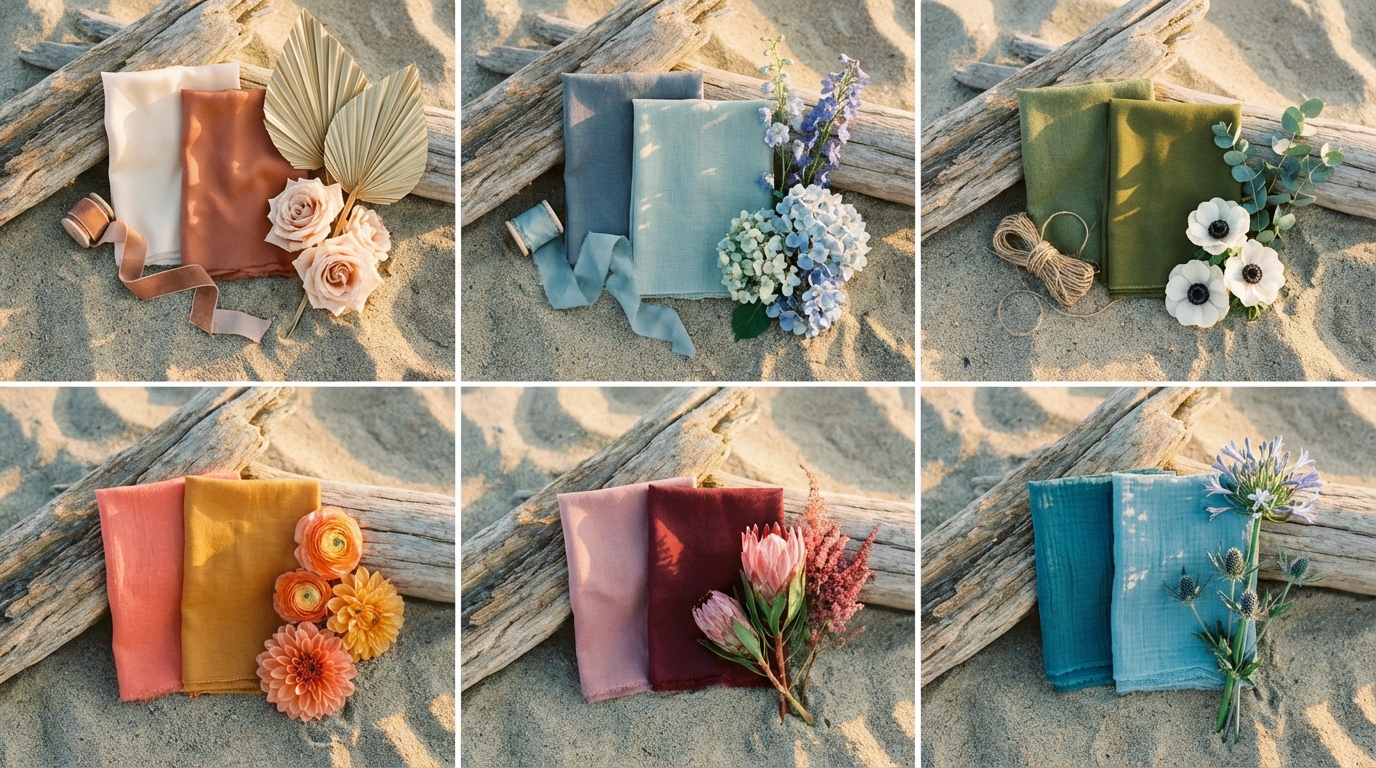
What are the 6 palette directions that consistently work at beach venues?
1. Terracotta, Sage, and Warm Cream
This is the palette that surpassed navy-and-white in actual beach wedding bookings starting around 2023, and for good reason: terracotta is one of the most sun-stable colors in existence, sage photographs in every light condition, and warm cream reads as luxurious next to sand.
Carrying it through your wedding:
- Florals: dried pampas grass, dried eucalyptus, dusty miller, burnt orange dahlias (use sparingly: they wilt in heat, see Article 2), protea, rust-colored ranunculus. Supplement with fresh tropical greens that won’t wilt.
- Bridesmaid dresses: terracotta is widely available in chiffon and satin; Birdy Grey and Azazie have strong options at $100-$180. Mix bridesmaid terracotta with one or two in dusty sage.
- Linens: warm linen-texture tablecloths in cream, terracotta napkins, sage ribbon. Avoid crisp white linen: goes gray in shade.
- Stationery: kraft paper with terracotta and sage ink, watercolor botanical illustrations, warm gold foil for monograms.
- Cake: naked or semi-naked buttercream, sugar flowers in rust and dusty peach, dried flower garnishes.
- Groomsmen: khaki or warm linen suits, terra-cotta tie or pocket square, sage boutonniere.
Best for: Tulum, Bali, Costa Rica, Hawaii (sunset-facing beaches), fall weddings anywhere.
2. Coral, Gold, and Ivory
The classic tropical palette that’s survived every trend cycle because it’s essentially what you get when you photograph a beach sunset and match the light.
Carrying it through your wedding:
- Florals: birds of paradise, anthurium, plumeria, golden heliconia, tropical greenery. All of these are native to tropical environments and will hold for 8+ hours. No conditioning tricks needed.
- Bridesmaid dresses: coral in chiffon is universally flattering at beach venues. Mix with ivory for a tonal palette.
- Linens: ivory base, gold chargers, coral napkins. Gold flatware elevates immediately.
- Stationery: cream card stock, gold foil, warm watercolor wash in coral and amber.
- Cake: fondant in ivory with gold leaf, coral sugar blooms or real flowers pressed in.
- Groomsmen: white linen suits, gold pocket square, coral boutonniere or a tropical flower.
Best for: Caribbean, Mexico, Hawaii, Florida. Any sunset ceremony.
3. Dusty Blue, White, and Warm Sand
A cooler palette that needs careful management at beach venues: the key is “dusty” not “bright.” Bright blue competes with the ocean and looks cartoonish in photos. Dusty blue feels more like ocean mist, which is the right register.
Carrying it through your wedding:
- Florals: white garden roses (keep them in water until 30 minutes before ceremony), blue thistle, eucalyptus, white anemones, baby’s breath. For tropical venues, substitute white orchids for garden roses.
- Bridesmaid dresses: dusty blue or slate: specifically avoid cornflower blue or bright royal blue. Dessy and Jenny Yoo both have strong dusty blue ranges.
- Linens: warm white tablecloths (not bright white), slate blue napkins, natural wood chargers or gold.
- Stationery: white card with dusty blue watercolor wash, silver calligraphy or pressed botanical elements.
- Cake: white fondant with blue watercolor wash, pressed flowers, silver leaf.
- Groomsmen: navy suit with dusty blue tie, or a crisp white linen suit with a blue pocket square.
Best for: Greece (Santorini, Mykonos), Hawaii blue-water beaches, Florida Gulf Coast. Winter Caribbean. Not ideal for golden-hour ceremonies in direct sun.
4. Tropical Green, White, and Gold
Going green-forward is underused and wildly effective at lush beach venues: Bali, Costa Rica, Tulum’s cenote areas, Hawaii’s north shores. This palette leans into the environment rather than fighting it.
Carrying it through your wedding:
- Florals: monstera leaves, palm fronds, tropical greenery is the star here. White anthuriums, white dendrobium orchids, small white plumeria as accents. The greenery doesn’t need to be arranged: lush and full reads like abundance.
- Bridesmaid dresses: white, ivory, or champagne. Green as a dress color works for one accent bridesmaid but tends to disappear into tropical foliage. Let the greenery provide the green.
- Linens: white base, woven rattan chargers, greenery runners directly on the table (no vases needed).
- Stationery: white card, tropical leaf prints, gold calligraphy.
- Cake: white fondant or buttercream with tropical greenery pressed in, gold drip.
- Groomsmen: white linen suits, green boutonniere, no tie or a minimal one.
Best for: Bali, Costa Rica, Tulum, Hawaii (Hana coast, North Shore). Venues with lush tropical settings.
5. Navy, Coral, and Crisp White
The most searched beach wedding palette and genuinely one of the best for nautical or more formal beach venues: historic Key West properties, resort venues, New England beaches.
The trick: use coral rather than blush. Blush goes gray-pink in afternoon sun. Coral holds its temperature.
Carrying it through your wedding:
- Florals: white hydrangea (holds well in mild heat), white ranunculus, coral peonies (spring only), white spray roses, tropical greenery accents.
- Bridesmaid dresses: navy in a lighter fabric (chiffon, georgette) so it doesn’t look like a uniform. Or mix navy and coral.
- Linens: navy tablecloths feel heavy: prefer white base with navy napkins, navy ribbon on centerpieces.
- Stationery: white card, navy ink, coral wax seal. Classic and readable.
- Cake: white with navy ribbon detail and sugar coral blooms.
- Groomsmen: navy suit (any climate works here), white shirt, coral tie.
Best for: Key West, New England beaches, Bermuda, more formal Caribbean resorts. Formal venues and morning/midday ceremonies.
6. Blush, Champagne, and Greenery
The romantic option: softer, more neutral, works at nearly every venue. The challenge at beach venues is that blush is light and can wash out. The solution is to anchor it with champagne and warm neutrals rather than white.
Carrying it through:
- Florals: blush peonies (spring and early summer only: they don’t survive heat), white garden roses, ranunculus in soft peach, dried pampas grass, eucalyptus. For tropical destinations, use white orchids and protea instead of peonies.
- Bridesmaid dresses: blush or champagne, or mix the two tones. Make sure the fabric has some depth: a thin fabric in blush goes nearly transparent in bright sun.
- Linens: champagne tablecloths, blush napkins, gold flatware. Avoid white linens with this palette: they make the blush look washed out rather than intentional.
- Stationery: warm vellum, blush watercolor, gold calligraphy.
- Cake: champagne or pale gold buttercream with blush blooms, gold leaf accents.
- Groomsmen: warm khaki or a champagne-toned linen suit. Blush ties photograph very soft and pretty.
Best for: Punta Cana, Jamaica resort weddings, Hawaii’s more manicured venues, Florida Gulf Coast. Spring weddings. Any venue with lush, manicured grounds.
Which colors photograph badly at beach weddings?
This is the section most color guides skip, so pay attention.
Lavender and lilac: Golden-hour light adds red and orange tones to everything. Lavender, which is already a mix of blue and red, shifts toward a muddy brownish-purple in warm light. In shade, it goes gray. It’s the most reliably disappointing color in beach wedding photos. If you love purple, go deep: plum, eggplant, and deep violet are stable and gorgeous.
Pale yellow: Washes out completely in bright sun. Your bridesmaid in pale yellow stands next to a white sand beach and she’s just… gone. Pale yellow works in soft morning light in non-beach environments. In direct beach sun, it disappears.
Neon and highly saturated brights (hot pink, electric blue, chartreuse): These colors are designed to grab attention indoors where everything is neutral. Outdoors in direct sun, they become overexposed: the camera can’t hold the color detail. The result looks like a digital glitch rather than a fashion choice.
Cool mint: One of the most requested colors that looks worst on film. The greenish-blue balance that makes mint feel fresh indoors shifts hard toward yellow-green in golden-hour light. It doesn’t read as a deliberate palette choice; it reads as a color correction error.
Bright white as a dominant palette color: Bright white competes with the bride’s dress, goes gray in shade, and creates harsh contrast in direct sun. Use warm white, ivory, and cream as your neutrals instead.
A palette comparison table
| Palette | Best venue type | Best season/time | Vibe | Avoid if… |
|---|---|---|---|---|
| Terracotta + Sage + Cream | Open beach, jungle, villa | Year-round, sunset ceremony | Earthy, romantic, modern | You want traditional or nautical |
| Coral + Gold + Ivory | Resort, open beach | Year-round, any time | Tropical, festive, classic | You want minimal or moody |
| Dusty Blue + White + Sand | Formal resort, Mediterranean | Winter Caribbean, morning | Airy, romantic, elegant | Golden-hour ceremony in direct sun |
| Tropical Green + White + Gold | Jungle villa, lush venue | Year-round | Lush, bold, natural | You want a soft or pastel mood |
| Navy + Coral + White | Historic venue, formal resort | Year-round, morning/midday | Nautical, polished, preppy | Casual or boho setting |
| Blush + Champagne + Greenery | Manicured resort, garden beach | Spring, mild temperatures | Soft, romantic, timeless | Tropical heat or very bright midday sun |
How do you build a “color story” across every touchpoint?
A color palette isn’t just bridesmaid dresses. It’s a story that starts with your save-the-date and ends with the ribbon on your going-away bag. When it’s consistent, your wedding photos look curated rather than assembled.
Map your palette against every touchpoint: invitations, ceremony programs, flower girl baskets, petal colors, aisle runner, ceremony chair sash, cocktail hour napkins, escort cards, centerpieces, table linens, chargers, flatware, cake, menus, bar signage, and favors.
You don’t need to use every color at every touchpoint: that feels cluttered. Think of your palette as having a primary (dominant everywhere), a secondary (used generously at reception), and an accent (appears at 3-5 moments for emphasis). Coral + Gold + Ivory, for example: coral is primary (florals, bridesmaid dresses), ivory is secondary (linens, invitations), gold is the accent (chargers, flatware, a gold-drip cake).
The “color story” concept means that a guest walking in to your ceremony and then through to your reception sees a visual thread: they feel the cohesion even if they couldn’t tell you what it is.
Ready to start planning your actual wedding? Take our short quiz and we’ll match you with planners and photographers in your destination who work with your vision and budget. If you’re still sorting out the big-picture plan, our destination wedding guide is the right starting point.