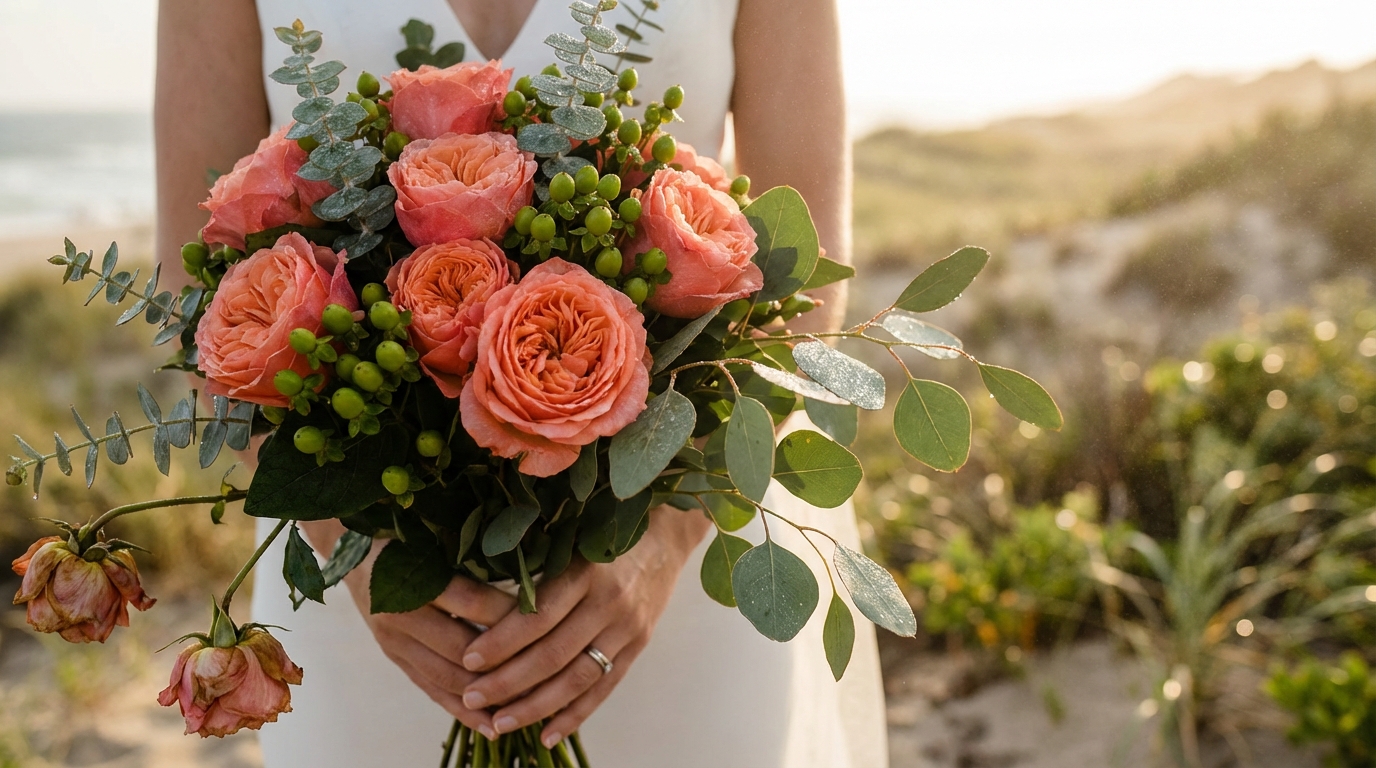
A beach bridal bouquet has to do something no church or ballroom bouquet ever faces: survive a photoshoot in direct sun, a walk across hot sand, a 45-minute ceremony in humid air and salt breeze, and then cocktail hour without looking like it gave up halfway through.
Most florists know this. But brides who fall in love with a particular flower on Pinterest sometimes don’t, and the results are predictable: wilted petals in the ceremony photos, a bride holding what looks like a defeated garden.
This guide covers what actually survives, what doesn’t, and how your florist can squeeze maximum life out of even moderately heat-sensitive flowers when conditions are right.
What are the real enemies of a beach bouquet?
Heat, humidity, salt air, and wind each attack flowers differently. Understanding the mechanism tells you whether conditioning and water picks will help: or whether the flower just isn’t right for your venue.
According to the American Society of Floral Designers, proper post-harvest handling is the single most important factor in flower longevity: temperature management during transport and conditioning before the event account for the majority of shelf-life variation.
Heat is a desiccant. It accelerates transpiration: flowers lose water through their petals faster than their stems can supply it. Thin-petaled flowers (sweet peas, anemones, lisianthus) simply can’t keep up in temperatures above 80°F. Their petals go translucent, then brown at the edges, within 2-3 hours. Heat is also the reason direct sun exposure matters so much: a bouquet in 85°F ambient air sitting in direct sun is experiencing something closer to 100°F at the surface.
Humidity is a double-edged problem. High humidity slows transpiration, which helps heat tolerance slightly. But it also creates the ideal environment for botrytis: the gray mold that attacks rose petals, garden blooms, and soft-petaled flowers. A rose that looks perfect at 8am can show soft spots and petal collapse by noon in 85°F and 85% humidity. Humidity also softens stems on non-woody flowers, causing drooping even when the petals look fine.
Salt air is primarily a threat to flowers that aren’t native to coastal environments. Most tropical flowers shrug it off: they evolved in it. But flowers imported from temperate regions (garden roses, dahlias, sweet peas, peonies) absorb salt through their petals, which desiccates them faster. The effect isn’t dramatic at sea level on a calm day, but on a breezy beach with spray, you can see garden roses starting to crisp at the petal edges within 2 hours.
Wind is the most underestimated factor. A steady ocean breeze creates accelerated transpiration across petals: the same mechanism as wind-chill for humans, but for flower drying. Wind also causes mechanical damage: petals loosen and drop, fragile blooms like ranunculus can literally blow apart, and bouquets get knocked around during the processional. Structured, sturdy flowers (anthuriums, orchids) handle wind well. Loose, many-petaled flowers (garden roses, peonies, dahlias) don’t.
Which flowers genuinely survive 6-8 hours at a beach wedding?
The answer starts with a simple principle: tropical natives evolved for exactly these conditions. They’re not being asked to survive something foreign: they’re in their natural environment.
Orchids (Dendrobium, Phalaenopsis, Vanda) are the top-tier beach bouquet flower. They handle heat up to 95°F, thrive in humidity, ignore salt air, and their waxy petals resist both wind and mechanical damage. Dendrobiums are the workhorses: long stems, abundant blooms, available in white, purple, lavender, and yellow. Vandas are showier, in deeper blues, purples, and patterns. Phalaenopsis are elegant and widely available. Cost: $8-$25 per stem depending on variety.
Anthuriums are nearly indestructible in tropical conditions. Their waxy, lacquered appearance means they look fresh far longer than they technically need to. Available in red, coral, pink, white, and deep burgundy. They’re graphic and bold: perfect as a structural anchor in a tropical arrangement. Cost: $4-$8 per stem.
Birds of paradise (Strelitzia) are dramatic and architectural. They don’t wilt: the flower is essentially woody. They work best in larger arrangements and destination weddings with a more adventurous aesthetic. Cost: $6-$15 per stem.
Heliconia: the lobster claw flower: adds vertical drama and comes in red, orange, and yellow. Like birds of paradise, it’s essentially a tropical shrub flower that doesn’t understand the concept of wilting. Cost: $5-$10 per stem.
Plumeria (frangipani) is the quintessential tropical bloom: fragrant, soft, and beautiful. Here’s the catch: plumeria has no stem. Florists wire individual blooms for bouquet use, and with water picks, they hold 4-6 hours. Don’t plan on plumeria for an 8-hour beach day, but they’re beautiful for ceremony use.
Protea is available across tropical destinations and several Mediterranean ones (Santorini florists carry these). Native to South Africa and Australia, they’re heat-tolerant, last well, and add texture and scale to any arrangement. Cost: $8-$20 per bloom.
Tropical greenery: monstera, palm fronds, tropical ferns, ti leaves, banana leaf: rounds out any tropical arrangement. It all holds indefinitely in beach conditions because it’s essentially what’s growing 20 feet away.
Spray roses (not garden roses) are a reasonable compromise if you want the rose look. Smaller blooms, tougher petals, and hardier stem structure than garden roses. In mild heat (under 82°F) with water picks, they hold well for a ceremony. Not a guaranteed performer in high heat, but far better than garden roses.
Succulents deserve their own mention: if you use them as bouquet elements, they’re indestructible and beautiful. A succulent and tropical greenery bouquet with a few orchid accents is one of the most reliable beach bouquet recipes there is.
What does florist conditioning mean, and why does it matter?
Good florists don’t just arrange flowers on the morning of your wedding. They start the process 24-48 hours before and it makes a significant difference.
The conditioning sequence: Stems are cut at a 45-degree angle underwater (prevents air bubbles in the vascular tissue), placed immediately in clean water with a conditioning solution, and refrigerated at 34-38°F for 12-24 hours before arrangement. This ensures the flower’s vascular system is fully hydrated before it’s subjected to any stress.
Final assembly: Bouquets for beach weddings are assembled the morning of, refrigerated until 30-60 minutes before use, and each stem receives a water pick at final assembly. The florist typically delivers to your getting-ready location, and the bouquet stays in air conditioning until the processional starts.
Day-of protocol: Keep the bouquet in shade. Don’t set it in direct sunlight even for a few minutes while you’re waiting. Have a bridesmaid hold it in the shade while you’re in photos before the processional. These aren’t neurotic instructions: each 10 minutes in direct sun accelerates the deterioration timeline.
When you interview florists, ask specifically: “How do you condition flowers for outdoor beach weddings?” and “Do you use water picks on every stem?” If they don’t have clear answers to both questions, find someone else.
Which flowers should you avoid at beach weddings?
The beautiful but doomed list
Dahlias are magnificent flowers that genuinely don’t belong at warm-weather beach weddings. They wilt in heat above 75°F within 3-4 hours, full stop. The large café au lait dahlia you’ve been saving to Pinterest since 2022 will look like a deflated balloon in your 3pm ceremony photos if you’re in Cancun in October. In temperate conditions (a San Francisco beach wedding in September, a Pacific Northwest coastal venue), dahlias can work with excellent conditioning. In the tropics: no.
Garden roses require a realistic conversation with your florist. In air-conditioned venues, garden roses are magnificent and last for days. In beach conditions above 80°F, they start losing petals within 4-5 hours. The conditioning and water pick protocol can help, and in mild coastal weather (Hawaii at a morning ceremony, Florida in November), they can be beautiful. But your florist should be honest with you about the risk, and you should plan accordingly: garden roses for your photos and arrival, substituting hardier flowers for any arrangement that needs to last through the evening reception.
Sweet peas are for indoor venues only. Delicate petals, no heat tolerance, no humidity tolerance. They’re extraordinarily beautiful and this is genuinely unfortunate.
Peonies are the most requested flower at beach weddings and the most unreliable in warm temperatures. In shoulder season at temperate beach destinations (early May in California, November in Florida), peonies with very good conditioning can survive a morning ceremony. In tropical summer heat: no. Also, peonies are seasonal (spring only in the Northern Hemisphere), so destination weddings outside that window can’t access fresh peonies regardless.
Anemones are fragile in heat and humidity. Beautiful for indoor spring weddings. Not right for hot-weather beach venues.
Ranunculus are another Pinterest favorite that struggles outdoors. Wind blows petals off. Heat wilts them. High humidity causes soft spots. These work beautifully in mild coastal conditions but are not a safe choice for Caribbean or Mexican tropical weddings.
What are the non-flower bouquet alternatives?
Succulent bouquets
Round, lush, geometric. Succulents are rooted plants that tolerate anything: heat, sun, dry air. A fully succulent bouquet is practically indestructible. The aesthetic is modern and architectural, not soft and romantic. After the wedding, your bridesmaids can replant individual succulents as favors. Cost: $150-$350 for a bridal bouquet.
Tropical foliage-only
All-greenery bouquets using monstera, tropical ferns, ti leaves, palm varieties, and broad-leafed tropicals. No flowers at all, or flowers as a minimal accent. This is one of the most beautiful and genuinely tropical looks for a beach wedding. The foliage typically costs less than florals, lasts longer, and looks inherently right at a beach venue. Cost: $100-$250.
Air plant arrangements
Tillandsia (air plants) are sold by weight, require no soil or water, and survive for days without any care. They can be wired into a sculptural bouquet that looks modern and unusual. Very low cost. The aesthetic is somewhat avant-garde: beautiful if that’s your style, odd if it isn’t. Cost: $75-$200.
Shell and botanicals
Some couples incorporate shells, sea glass, or driftwood elements into their florals. These elements obviously survive any conditions. They work best as accents rather than primary structural elements, wired alongside tropical flowers and greenery.
How do flower options vary by destination?
Hawaii
Local flower availability is exceptional: plumeria, anthurium, birds of paradise, dendrobium orchids, ginger, protea. Nearly everything tropical is grown locally. Florists on Maui, Oahu, and Kauai are experienced with outdoor beach ceremonies. Garden roses and peonies are available if you want them, but they’re imported from the mainland and cost more. Budget: $250-$500 for a medium bridal bouquet using locally-sourced tropical flowers.
Caribbean (Cancun, Punta Cana, Jamaica)
Tropical florals are widely available: anthuriums, orchids, tropical greenery all locally sourced. Soft temperate flowers (garden roses, peonies, sweet peas) are imported and cost more, and your florist will likely advise against them for outdoor ceremonies in July-October peak hurricane-adjacent heat. November-April, conditions are milder and more options are viable. Budget: $200-$450 for a bridal bouquet.
Santorini
This is the most different florals situation. Santorini is Mediterranean, not tropical. The island is very dry, warm in summer, and florists typically use: white garden roses, pampas grass, dried flowers, bougainvillea, lavender, anemones, protea, and some imported tropical flowers. The aesthetic is very different from Caribbean tropical: more wildflower, more Mediterranean. Budget: $300-$600 for a bridal bouquet, because most florals are imported to the island.
Bali
Extraordinary local flower availability. Frangipani/plumeria grows wild. Orchids, tropical greenery, birds of paradise, jasmine, marigold, lotus. Bali florals are generally less expensive than other destinations because labor costs are lower. Budget: $100-$300 for a bridal bouquet.
Flower survival comparison table
| Flower | Heat tolerance | Humidity tolerance | Wind resistance | Typical cost/stem | Available in tropics |
|---|---|---|---|---|---|
| Dendrobium orchid | Excellent | Excellent | Good | $8-$15 | Yes |
| Anthurium | Excellent | Excellent | Excellent | $4-$8 | Yes |
| Birds of paradise | Excellent | Excellent | Excellent | $6-$15 | Yes |
| Heliconia | Excellent | Excellent | Excellent | $5-$10 | Yes |
| Protea | Good | Good | Good | $8-$20 | Yes (Hawaii, Bali, Santorini) |
| Spray roses | Fair | Fair | Fair | $3-$6 | Imported |
| Garden roses | Poor-Fair | Poor | Fair | $4-$10 | Imported |
| Dahlias | Poor | Poor | Poor | $5-$12 | Imported |
| Peonies | Poor | Poor | Fair | $8-$15 | Imported, seasonal |
| Sweet peas | Poor | Poor | Poor | $3-$5 | Imported, seasonal |
| Succulents | Excellent | Excellent | Excellent | $2-$8 per plant | Yes |
Planning your flowers is just one piece of the destination wedding puzzle. Use our beach wedding checklist to make sure you haven’t missed anything, or take the quiz to get matched with experienced local florists and planners at your destination: people who work in your specific climate every week and know exactly what holds up.