You’ve picked the venue, chosen the flowers, and maybe even found the perfect pair of sandy-aisle shoes. But have you thought about how you’ll actually get there? Beach wedding transportation ideas go far beyond booking a white limo. The right transport sets the tone for your entire day, solves real logistical puzzles (like parking on sand), and gives your photographer some of the best shots of the celebration. Whether you picture yourself stepping off a sailboat or rolling up in a vintage Jeep, this guide covers every option, with real costs, destination-specific picks, and the timeline details most articles skip.
What Is Beach Wedding Transportation (And Why It’s More Than Just a Pretty Entrance)?
Beach wedding transportation covers every vehicle, vessel, or creative ride that moves you, your wedding party, and your guests between hotels, ceremony sites, and reception venues on your wedding day.
Think of it in three layers. First, there’s the couple’s arrival, the cinematic moment everyone photographs. Second, there’s the bridal party transport, which keeps your crew together and on schedule. Third, and often the most overlooked, there’s guest logistics: shuttles, transfers, and parking solutions that prevent your loved ones from wandering a beachside road in heels.
According to The Knot’s 2024 Real Weddings Study, the average U.S. wedding transportation cost is $1,075, and destination weddings push that to $1,190. Weddings with over 100 guests spend nearly $1,200 on transportation alone. Those numbers climb quickly at beach venues where parking is scarce, roads are narrow, and the ceremony site might only be reachable by boardwalk or boat.
So yes, your entrance matters. But so does making sure Grandma doesn’t have to trek through a quarter mile of sand in the midday sun. A good transportation plan handles both.
What Factors Should You Consider Before Booking Wedding Transportation?
Start with your guest count, venue terrain, and the distance between your hotel and ceremony site, then work backward to the right vehicle.
Here are the key factors that shape every decision:
Guest count and vehicle sizing. According to Lamers Bus Lines, limousines hold about 8 people, mini coaches and party buses fit 14 to 24, and trolleys can carry up to 40. For larger groups, double-decker buses hold 60 to 120 passengers. Match your headcount to the right vehicle before you fall in love with a look.
Terrain and accessibility. Sand, gravel paths, and narrow coastal roads eliminate many standard vehicles. Party buses that work perfectly in a city may not fit down a one-lane beach road in Tulum or Key West. Always ask vendors whether their vehicles can handle your specific venue’s access points.
Booking timeline. Book 6 to 8 months in advance, especially for peak summer Saturdays or holiday weekends. Popular beach destinations fill up fast, and waiting means you’ll be choosing from whatever’s left.
Weather and tide windows. Water-based transport depends on conditions. If you’re planning a catamaran arrival, you need a land-based backup. Build flexibility into your contracts.
Budget reality. According to The Knot, town cars and limos run $75 to $150 per hour, while party buses can hit $200 to $300 per hour. Most vendors require 3- to 4-hour minimums. Costs vary significantly based on season, guest count, and specific vendors.
The 15 Best Beach Wedding Transportation Ideas (Ranked by Vibe)
Here are 15 options organized from laid-back to luxe, with capacity and best-fit details for each.
Casual and Carefree
- Golf carts (2-6 passengers) - Perfect for resort weddings where everything is on-property. Many Cancun and Punta Cana resorts include these.
- Vintage VW van (6-8 passengers) - Ideal for boho beach vibes. Great photo prop. Best on paved coastal roads.
- Bicycles or tandem bikes (2 passengers) - Fun for short distances on flat beachfront paths. Think Holbox or a boardwalk ceremony.
- Open-air Jeep or Land Rover (4-6 passengers) - Handles sandy terrain that sedans can’t. A natural fit for Costa Rica or Jamaica weddings.
- Tuk-tuk or rickshaw (2-3 passengers) - Playful and colorful. Popular in Southeast Asian beach destinations like Koh Lanta or Bali.
Romantic and Classic
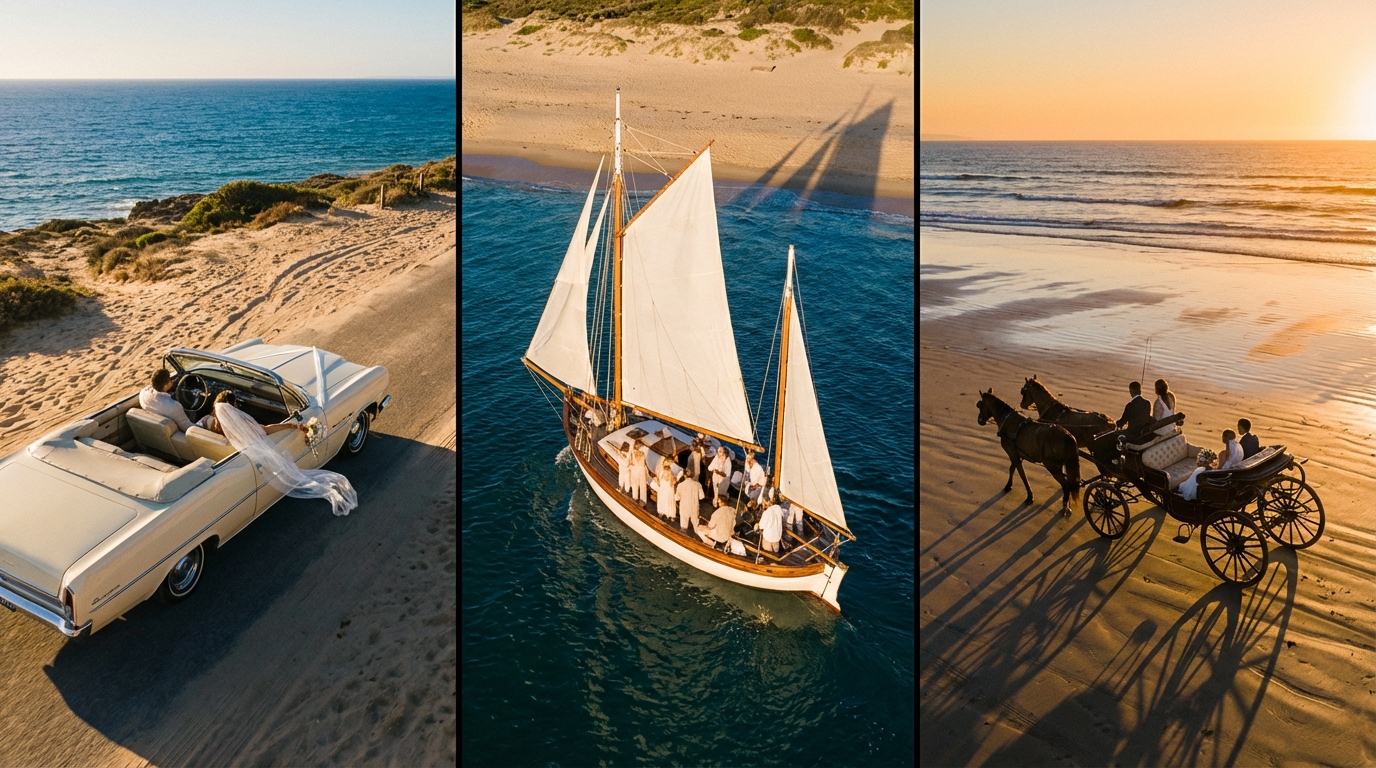
- Vintage convertible (2-4 passengers) - According to With Joy, vintage cars work best for shorter routes of up to 10 miles for reliability. Stunning for Amalfi Coast or Algarve coastal roads.
- Horse-drawn carriage (2-4 passengers) - A timeless choice for firm, packed-sand beaches or beachfront promenades.
- Gondola (2-6 passengers) - Best near calm waterways, lagoons, or canals. Plan for a 30-minute ride.
- Donkey or mule (1-2 passengers) - The iconic Santorini choice. Charming, slow, and very photogenic.
Nautical and Adventurous
- Sailboat (4-15 passengers) - According to Wedding-Spot.com, schedule at least 1 hour for the ride including docking time. Beautiful for Maldives or Fiji arrivals.
- Catamaran (10-30 passengers) - Stable on open water and spacious enough for the full bridal party. Many Caribbean resorts offer these as part of wedding packages.
- Speedboat (4-8 passengers) - Fast, dramatic, and perfect for island-hopping destinations. Works well in the Riviera Maya.
- Rowing boat or canoe (2-4 passengers) - Intimate and quiet. Best on calm bays or lagoons. Note: there’s a real risk of getting splashed, so plan your outfit accordingly.
Grand and Luxe
- Yacht (10-50+ passengers) - The ultimate statement. Can double as a cocktail hour venue. Budget-dependent but unforgettable.
- Helicopter (2-6 passengers) - For couples who want maximum drama. Requires a flat landing zone near the venue and advance coordination with local authorities.
Which Transportation Works Best at Each Destination?
The right ride depends entirely on where you’re saying your vows. Here’s a quick-reference guide matching transport types to popular beach wedding destinations.
| Destination | Best Transport Options | Why It Works | Watch Out For |
|---|---|---|---|
| Hawaii | Vintage convertible, shuttle van, outrigger canoe | Island roads are well-paved; outriggers honor local culture | Resort areas get congested; book shuttles early |
| Cancun / Riviera Maya | Resort golf cart, catamaran, open-air trolley | All-inclusive resorts often include on-property transport | Sand access limits standard vehicles |
| Santorini | Donkey, private boat transfer, ATV | Steep caldera paths and narrow streets rule out large vehicles | Donkeys book out months ahead in peak season |
| Amalfi Coast | Vintage Fiat, private speedboat, water taxi | Winding cliffside roads are part of the charm | Large buses cannot fit on most Amalfi roads |
| Tulum | Vintage Jeep, bicycle, ATV | Unpaved jungle roads and eco-zone restrictions favor smaller vehicles | Many roads are sandy or unpaved |
| Jamaica | Open-air Jeep, catamaran, resort shuttle | Relaxed vibe matches casual transport | Confirm vendors are licensed operators |
| Maldives | Speedboat, seaplane, dhoni (traditional boat) | Islands are only reachable by water or air | Weather delays are common; always have a backup |
| Key West | Trolley, vintage convertible, scooter | Flat terrain and short distances make everything accessible | Limited parking downtown; shuttles are smart |
| Punta Cana | Resort shuttle, catamaran, horse-drawn carriage | Many all-inclusive resorts bundle transport into packages | Check what’s actually included vs. add-on pricing |
| Bali | Tuk-tuk, vintage VW, traditional jukung boat | Balinese culture offers unique local options | Traffic near Seminyak/Kuta can cause major delays |
According to The Knot, domestic destination weddings (like Hawaii) average $1,204 in transportation costs, while international destinations average $839. That gap often comes down to the scale of guest shuttling required at U.S.-based beach venues.
How Much Does Beach Wedding Transportation Actually Cost?
Expect to spend between $500 and $2,500 or more, depending on your guest count, vehicle type, and destination.
Here’s a breakdown of typical hourly rates based on data from The Knot and LA Coach USA:
| Vehicle Type | Capacity | Hourly Rate | Typical Minimum |
|---|---|---|---|
| Town car / sedan | 2-4 | $75 - $150 | 3 hours |
| Limousine | 6-8 | $100 - $200 | 3 hours |
| Sprinter van | 10-14 | $125 - $225 | 3 hours |
| Minibus (20-30 seats) | 20-30 | $150 - $250 | 3 hours |
| Coach bus (40-56 seats) | 40-56 | $200 - $350 | 3 hours |
| Party bus | 14-24 | $200 - $300 | 3-4 hours |
| Sailboat charter | 4-15 | $200 - $500+ | 2 hours |
Regional differences matter too. According to The Knot, couples in the Northeast spend an average of $1,500 on wedding transportation, while those in the Southwest average $755. Beach weddings often land at the higher end ($1,500 to $2,500+) because of logistics like sand access, extended wait times, and peak-season demand.
A few ways to keep costs reasonable: choose drop-off and pick-up service instead of hourly holds, consolidate guests at one or two pickup points, and ask your resort about bundled transportation packages. Some all-inclusive resorts{rel=“noopener noreferrer sponsored”} in the Caribbean include catamaran transfers or resort shuttles as part of their wedding packages.
Costs vary significantly based on season, guest count, and specific vendors. Always request itemized quotes from at least three providers.
What About Guest Shuttles: Do You Really Need Them?
If your guests are staying at hotels more than a short walk from your venue, the answer is almost always yes.
Guest shuttles solve three problems at once: parking shortages at beach venues, safety concerns when alcohol is involved, and the stress your out-of-town guests feel trying to find an unfamiliar location. According to The Knot, couples with 50 or fewer guests spend an average of $583 on transportation, while those with 100+ guests average nearly $1,200. Even smaller weddings benefit when the venue is remote.
Here’s a practical approach to deciding:
- Count your out-of-town guests first. They’re the ones who need shuttles most. Locals may drive themselves.
- Check rideshare availability. In rural beach areas or small islands, Uber and Lyft may not operate reliably. Don’t assume they’ll be there.
- Designate central pickup points. Rather than hitting every hotel, choose one or two locations and communicate clearly on your wedding website.
- Plan for the end of the night. Late-night return shuttles are just as important as the ones getting guests to the ceremony. Schedule a final departure 30 minutes after your last song.
One thing to keep in mind: not everyone will use the shuttle. According to a WeddingWire forum discussion, younger guests tend to ride shuttles more, while families with children and older guests often prefer their own vehicles. Estimate about 60 to 70 percent usage when sizing your shuttle.
How Do You Build Transportation Into Your Wedding Day Timeline?
Add 20 to 50 minutes of buffer time for every transportation segment, and work backward from your ceremony start time.
Beach weddings are especially vulnerable to timeline slippage. Sand slows everyone down. Photo locations may be a walk from the ceremony site. And if you’re using water transport, docking and disembarking take longer than you’d think.
Here’s a sample timeline for a 4:30 PM beach ceremony:
- 1:00 PM - Hair and makeup complete; couple gets dressed
- 2:00 PM - First look and couple portraits (if doing them before the ceremony)
- 2:45 PM - Wedding party photos
- 3:30 PM - Wedding party boards transport to ceremony site
- 3:50 PM - Guest shuttle departs from hotel(s)
- 4:10 PM - Guests arrive and are seated
- 4:20 PM - Wedding party arrives; final lineup
- 4:30 PM - Ceremony begins
- 5:00 PM - Ceremony ends; couple departs for sunset photos
- 5:30 PM - Guests shuttle to reception venue (or walk if on-site)
According to Yellow Umbrella Events, allocating 20 to 50 minutes for wedding party transport to the ceremony site prevents the cascading delays that ruin timelines. For beach settings, lean toward the longer end of that range.
A few more timeline tips: schedule your ceremony at least 90 minutes before sunset so you have golden-hour light for photos after. Confirm your shuttle driver has the exact address and any gate codes. And always share the full timeline with your transportation vendor, not just the pickup time. For a complete planning framework, check out our destination wedding guide.
How BeachBride Can Help You Find the Right Vendors
Planning transportation from thousands of miles away is one of the trickiest parts of a destination wedding. You can’t exactly test-drive a vintage Jeep in Tulum from your apartment in Chicago.
That’s where we come in. At BeachBride, we connect couples with vetted local wedding planners and transportation vendors who know their destination inside and out. They know which roads flood during rainy season, which boat captains are reliable, and which resort shuttles are worth the upgrade fee.
Our approach is simple: tell us your destination, your vibe, and your guest count, and we’ll point you toward vendors who specialize in exactly what you need. No generic directories. No scrolling through hundreds of irrelevant listings.
If you’re still narrowing down your destination, our destination wedding cost guide breaks down what to budget for each location, transportation included.
You’ve got the ideas. You’ve got the cost ranges. Now it’s time to match all of this to your specific destination and style. Take the BeachBride quiz to get personalized vendor recommendations for your beach wedding, including transportation pros who know your destination like the back of their hand. It takes about two minutes, and it’ll save you hours of searching.