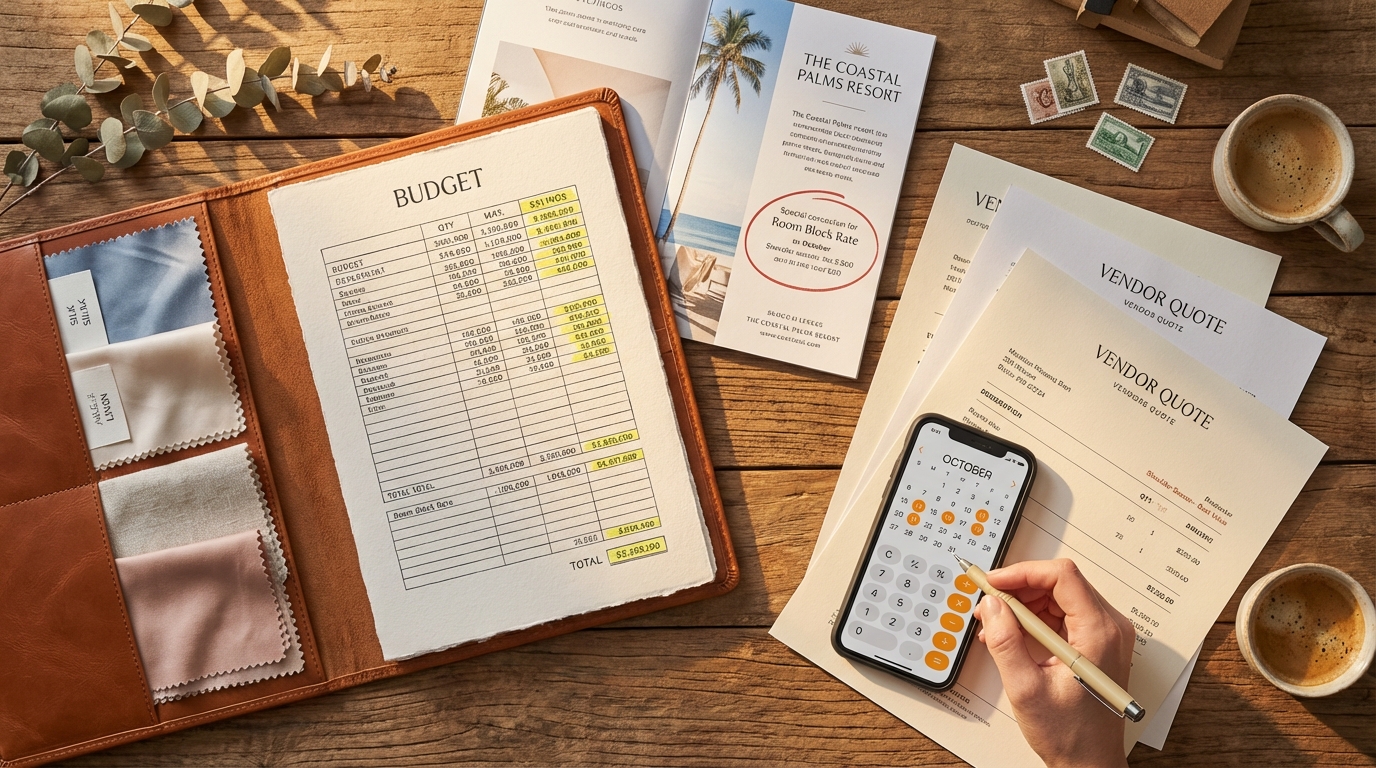
Here’s something that surprises almost every couple we talk to: you can genuinely save money with a destination wedding. Not by cutting corners or settling for less, but by rethinking where your budget actually goes. The math works differently when you swap a 150-person hometown reception for an intimate beach ceremony with your favorite people. And once you see the real numbers, the “destination weddings are expensive” myth starts to fall apart fast.
This guide breaks down exactly how the savings work, which destinations stretch your dollar furthest, and where to watch for hidden costs that can eat into those savings if you’re not paying attention.
The Counterintuitive Truth: Why Destination Weddings Often Cost Less
The biggest reason destination weddings cost less has nothing to do with cheaper venues or exchange rates. It’s the guest list.
According to The Knot, the average U.S. hometown wedding costs around $33,000. Meanwhile, all-inclusive resort packages can bring a 40-to-50-person destination wedding in at $10,000 to $20,000 in places like Riviera Maya or Punta Cana. That’s not a typo. When you’re feeding and entertaining half as many people, the numbers shift dramatically.
According to Travel Bash, guests actually spend less attending a destination wedding ($673 per person on average) than a traditional local one ($703). So the idea that you’re burdening your guests financially? The data doesn’t support it. Many guests treat the trip as a vacation, which changes the whole dynamic.
The other factor: bundling. A resort that includes your venue, catering, cake, DJ, and basic décor in one package eliminates the piecemeal vendor costs that balloon traditional wedding budgets. You’re not separately hiring a caterer, renting linens, booking a venue, and coordinating deliveries. It’s one contract, one price.
What Actually Drives the Cost of a Destination Wedding?
Five factors determine whether your destination wedding cost lands closer to $10,000 or $40,000.
Guest count is the single biggest lever. Every additional person adds food, drinks, seating, and favors. Cut your list from 120 to 50, and you’ve slashed the most expensive line items in your budget by more than half.
Location matters enormously. According to Romantics Travel, Mexico and Caribbean packages range from $5,000 to $12,000 for the core wedding, while comparable U.S. weddings with 80 to 100 guests run $30,000 to $40,000 or more.
Vendor travel is an often-overlooked cost driver. According to Catersource, bringing in outside vendors adds roughly 56 cents per mile plus $130 per night for hotel stays. If your photographer is flying in from another country, that adds up quickly.
Customization level creates the widest range. Flowers and décor alone can swing from $2,500 (budget) to $25,000 or more (luxury), according to Romantics Travel. The ceremony itself is often the cheapest part. It’s the reception upgrades that balloon budgets fastest.
Season and timing round out the picture. Off-season bookings in the Caribbean (September through November) can cut venue and vendor rates significantly. A Tuesday wedding in October at the same resort might cost 30% less than a Saturday in December.
Note: Costs vary significantly based on season, guest count, and specific vendors. The figures above are averages and starting points, not guarantees.
The Guest List Effect: Fewer Guests = Dramatically Lower Costs
Smaller guest lists are the single most powerful way to reduce wedding costs, regardless of location.
According to Alibaba Product Insights, the median destination wedding guest count dropped 22% from 2019 levels, falling from 92 guests in 2017 to 72 in 2023. That shift alone translates to thousands of dollars in savings on catering, rentals, and venue size.
Here’s the math that makes this concrete. Food and beverage typically eat up 35% or more of a traditional wedding budget, according to Kay Northrup Events. At $150 per plate (a moderate estimate for a U.S. wedding), dropping from 130 guests to 50 saves you $12,000 on catering alone. Add in reduced costs for rentals, favors, invitations, and seating, and the savings compound.
There’s also a psychological benefit that couples don’t always expect. When you invite 50 people instead of 150, every single person at your wedding genuinely wants to be there. They chose to travel for you. That changes the energy of the entire event.
One honest caveat: according to data from WeddingWire forums, couples often overestimate their RSVP yield. If you invite 100 people to a destination wedding, expect closer to 45 to 55 to actually attend, not the 70% you might assume. Plan your budget around realistic attendance, not your full invite list.
Which Destinations Give You the Most Bang for Your Budget?
Mexico and the Caribbean consistently offer the best value for beach weddings, but the range across destinations is wider than most couples realize.
According to Paradise Weddings, average all-inclusive wedding packages in Mexico and the Dominican Republic run $6,450 to $6,550 for 50 guests, including venue, ceremony, reception, food, cake, and DJ. Compare that to the $33,000 U.S. average, and the savings are stark.
According to Radical Storage, Colombia offers the lowest average destination wedding cost at roughly €4,597, while other South American options like Peru (€7,005) and Brazil (€7,881) also deliver strong value.
| Destination | Avg. Package Cost (50 guests) | What’s Typically Included | Best For |
|---|---|---|---|
| Cancun / Riviera Maya | $6,450 - $8,000 | Venue, food, cake, DJ, basic décor | Easiest logistics from the U.S. |
| Punta Cana | $6,500 - $9,000 | Similar all-inclusive bundles | Resort variety, direct flights |
| Jamaica | $5,000 - $10,000 | Venue, catering, coordinator | Laid-back vibe, reggae cocktail hour |
| Costa Rica | $8,000 - $15,000 | Venue, food, some décor | Eco-weddings, jungle + beach combos |
| Tulum / Holbox | $10,000 - $20,000 | Boutique venues, curated experiences | Bohemian style, smaller resorts |
| Bali | $10,000 - $18,000 | Venue, catering, florals | Stunning backdrops, strong dollar |
| Utah (domestic) | ~$17,380 total | Venue, vendors hired separately | Budget U.S. option, mountain scenery |
For couples open to hidden gem destinations, places like Colombia, Peru, and Thailand (averaging €17,420 according to Radical Storage) deliver full wedding experiences well below the global destination wedding average of €17,924.
Consult your local planner or the relevant country’s embassy to confirm current legal requirements for marrying abroad, as these change frequently.
All-Inclusive Resort Packages: Are They Really a Deal?
All-inclusive packages can be an excellent deal for the right couple, but they’re not the automatic bargain the marketing suggests.
According to Paradise Weddings, the average all-inclusive destination wedding package costs $6,450 to $6,550 for 2025, typically covering 50 guests with a beach or garden venue, ceremony, reception, food and drinks, cake, and DJ. Packages range from as low as $1,000 for micro-weddings to $20,000 for premium options.
That sounds incredible next to a $33,000 traditional wedding. But here’s what the brochure doesn’t emphasize: most packages exclude airfare ($500 to $600 per person), taxes and service charges (10 to 15%), premium venue upgrades, and any customization beyond the base offering. According to The Knot, the full cost of a destination wedding (including travel and all extras) averages $39,000 domestically or $41,000 internationally.
The real value of all-inclusive packages comes from the subsidy model. Resorts make their money on guest room bookings. When your 50 guests each book four or five nights at $300 to $400 per night, the resort can afford to offer your wedding package at a steep discount. Some resorts, like Sandals, offer packages starting around $3,850 for 50 guests.
The sweet spot: 30 to 60 guests at a mid-range all-inclusive resort in Mexico or the Caribbean. That’s where the package pricing, guest room revenue, and your actual out-of-pocket costs align best.
One important detail: packages don’t prorate. If your package includes up to 50 guests and only 35 attend, you pay the same price. Budget based on your realistic guest count, not the package maximum.
What Does a Budget-Friendly Destination Wedding Actually Look Like? (Real Numbers)
A real budget destination wedding isn’t about deprivation. It’s about smart choices that let you spend on what matters to you.
Here’s what the numbers look like at three different budget levels:
Under $5,000 (Micro-wedding or elopement): According to Barn at Crescent Lake, intimate packages for 2 to 10 people covering venue, officiant, bouquet, and a champagne toast start under $5,000. Add a photographer and a nice dinner, and you’re still well under budget. This works beautifully for couples who want the experience without the production.
$6,000 to $10,000 (Small destination wedding, 25-50 guests): According to Paradise Weddings, all-inclusive packages in Mexico for this range include venue, ceremony, reception with food and drinks, cake, and DJ. You’ll handle your own flights and might add a photographer upgrade, but the core wedding is covered.
$15,000 to $25,000 (Mid-range destination wedding, 50-75 guests): This is where you get real flexibility. Upgraded florals, a live musician for the ceremony, a premium venue within the resort, and a rehearsal dinner. According to Eden Photo and Film, this range typically breaks down to $3,000 to $7,000 for the venue, $5,000 to $10,000 for catering, and the rest spread across photography, music, and décor.
For a detailed breakdown of every line item, check out our destination wedding cost guide.
All cost figures vary significantly based on season, guest count, and specific vendors.
Where Couples Accidentally Overspend and How to Avoid It
Even budget-conscious couples hit unexpected costs. Here are the most common traps and how to sidestep them.
Shipping and baggage fees for DIY items. That handmade arch you built? Shipping it to Mexico might cost more than renting one there. According to Kay Northrup Events, DIY projects that seem like money-savers often turn into overspends once you factor in transport.
Splurge imbalance. According to Angel Springs Events, couples who blow their budget on one element (usually the venue or the dress) end up scrambling to cover everything else. Set price ceilings for each category before you start shopping.
Skipping the buffer. According to Complete Wedo, industry experts recommend adding a 10 to 15% buffer to your total budget for hidden costs like tips, currency exchange fees, extra baggage, and last-minute vendor charges. If your budget is $15,000, plan your spending around $13,000.
Late vendor bookings. According to Travel Bash, procrastinating on bookings (especially 9 to 12 months out) leads to premium pricing and limited options. Book early, particularly for peak-season dates.
Ignoring the 10 to 15% service charge. Many all-inclusive resorts add service charges and taxes on top of the quoted package price. Always ask for the all-in number before signing.
Our destination wedding budget hacks guide covers more strategies for keeping costs down without sacrificing the experience.
How Does a Destination Wedding Compare to a Traditional Wedding Budget?
Here’s the side-by-side comparison that puts the savings question to rest.
| Category | Traditional U.S. Wedding (130 guests) | Destination Wedding (50 guests) |
|---|---|---|
| Average total cost | $33,000 - $35,000 | $10,000 - $20,000 (package) |
| Venue | $10,000 - $15,000 | $3,000 - $7,000 (often bundled) |
| Catering | $10,000 - $18,000 | $5,000 - $10,000 (often bundled) |
| Florals/décor | $2,500 - $8,000 | $1,500 - $5,000 |
| Photography | $3,000 - $5,000 | $2,000 - $4,000 |
| DJ/music | $1,200 - $2,500 | Often included in package |
| Couple’s travel | $0 (local) | $1,000 - $3,000 |
| Honeymoon | $5,000 - $10,000 (separate trip) | Often built into the trip |
| Avg. guest cost to attend | $703/person | $673/person |
Sources: The Knot, Travel Bash, Destination Wedding Experts, Group Travel
The honeymoon factor is one that couples often overlook. With a traditional wedding, you pay for the wedding and a separate honeymoon trip. With a destination wedding, you’re already there. Many couples extend their stay by a few days and call it their honeymoon, saving $5,000 to $10,000 on a separate trip.
And here’s a thought: the money you save on the wedding itself could go toward something lasting. A lab-grown diamond ring that would have felt like a stretch suddenly fits comfortably in the budget. Or a down payment fund. Or a longer honeymoon extension. The point is, you get choices.
Use our beach wedding checklist to make sure you’re tracking every expense from the start.
How BeachBride Helps You Find the Right Vendors at the Right Price
Planning a wedding from thousands of miles away is hard. You can’t taste-test caterers or walk through venues on a random Tuesday. That’s exactly why we built BeachBride.
We connect you with vetted destination wedding planners and vendors who specialize in the locations you’re considering. These aren’t generic referrals. They’re professionals who know which resorts actually deliver on their package promises, which local florists do stunning work for half the price of imported arrangements, and which photographers know the best light at your specific beach.
According to The Budget Savvy Bride, independent vendors often charge significantly less than large companies due to lower overhead, while delivering comparable (or better) personalized service. A local photographer in Cancun who shoots weddings every week at your resort will likely outperform a U.S.-based photographer who’s never been there, and cost less after you factor in travel fees.
Our destination wedding guide walks you through the full planning timeline. But if you want personalized recommendations based on your budget, guest count, and style, the fastest path is our matching quiz.
Ready to see what your destination wedding could actually cost? Take the BeachBride quiz and get matched with vendors and destinations that fit your budget, your style, and the wedding you’ve been imagining. It takes about two minutes, and it might just save you thousands.