Here’s the truth about your destination wedding guest communication guide that most etiquette articles skip: your guests aren’t just deciding whether to attend a party. They’re deciding whether to spend $2,000 or more on flights, hotels, time off work, and childcare based on the information you give them. The average destination wedding guest spends roughly $2,000 to attend, including $1,400 on accommodation and $600 on airfare, as Condor Ferries notes.
That financial reality changes everything about how, when, and what you communicate. Every message you send, from the first save the date to the welcome letter waiting in their hotel room, either builds confidence or creates confusion. And confused guests become guests who RSVP yes but never book, or worse, guests who quietly resent the whole experience.
Save the Dates from Minted
Photo save the dates, magnets, and postcards designed by independent artists. Order 6+ months out for best price tiers and free recipient addressing.
Free guest address printing on orders 50+.
Browse Save the DatesThis guide walks you through every communication touchpoint with specific timelines, actual template wording, and strategies pulled from real destination wedding planning logistics. Not vague etiquette advice. Real dates, real words, real systems.
Why Guest Communication Is Higher Stakes at a Destination Wedding
Poor communication costs you guests, money, and sometimes relationships. The stakes are simply higher when travel is involved.
As Barefoot Bridal notes, only 50-75% of invitees attend destination weddings, compared to 75-85% for local celebrations. That gap exists because every guest faces real barriers: cost, time off work, passport logistics, childcare. A Shane Co. survey found that 73% of guests need at least five months’ notice to arrange travel, finances, and time off.
And here’s the part that stings: CBS News reports that 30% of guests who decline a destination wedding report damaged relationships with the couple afterward. Much of that damage comes from poor communication, not the travel ask itself. When guests feel blindsided by costs, confused about logistics, or guilty about declining, the relationship suffers.
Your communication strategy is your single best tool for maximizing attendance, minimizing awkwardness, and making sure every guest who does show up feels genuinely excited to be there.
Save the Dates: How Far in Advance and What Extra Info to Include
Send destination wedding save the dates 8-12 months before the wedding, or up to 12-24 months for international locations requiring passports or visas.
That timeline isn’t arbitrary. International destinations need the longer lead time, as Paperless Post notes, so guests can renew passports (current U.S. processing takes 6-13 weeks for routine applications), research visa requirements, and start saving. The 9-12 month window hits the sweet spot for most destination weddings, per TravelBash, giving guests enough time to plan without the details going stale.
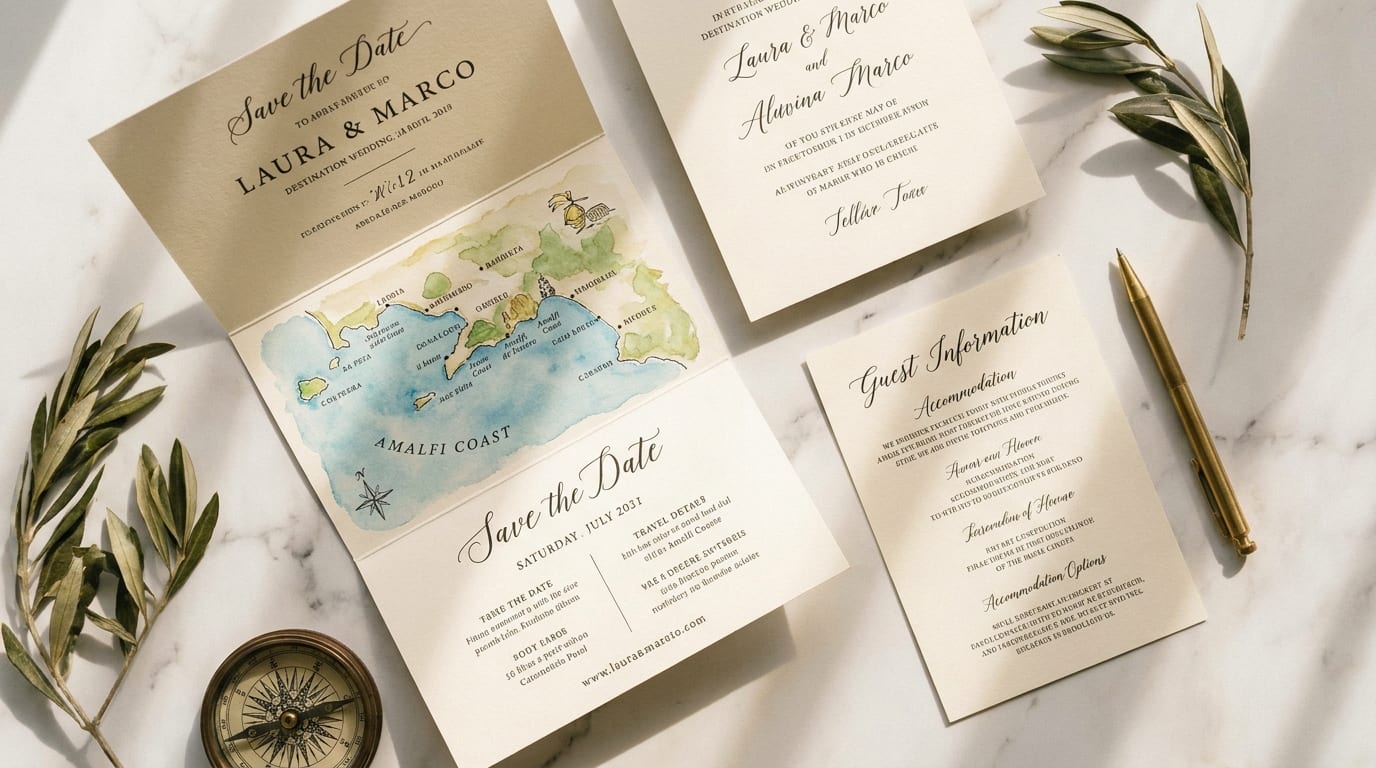
Your save the date needs to include more than a local wedding’s would:
- Date and location (city and country, not just “Mexico”)
- Your wedding website URL (this is non-negotiable for destination weddings)
- A note about travel: “More details on flights, hotels, and the full weekend at [website]”
- “Invitation to follow” so guests know this isn’t the formal invite
What you should not include yet: the full itinerary, hotel pricing, or detailed logistics. That’s what your wedding website and formal invitation are for. The save the date’s job is simple: give guests the date, the destination, and a place to start learning more.
If your wedding is at a popular destination during peak season, like a Cancun wedding in December or a Hawaii wedding in June, lean toward the earlier end of the timeline. Flight prices climb as dates approach, and your guests will thank you for the extra booking window.
How Do You Word a Destination Wedding Invitation Without Apologizing for the Travel Ask?
Lead with excitement about the place and the celebration, not guilt about the distance. Your guests are adults who can decide what they can afford.
The biggest mistake couples make is opening with something like “We know it’s a lot to ask…” or “We understand if you can’t make it.” That language frames your wedding as a burden before the guest has even finished reading. As Destination Wedding Details notes, the most effective invitation language treats the destination as part of the celebration, not an obstacle to it.
Here’s a template that works:
Together with their families, Sarah Mitchell and James Rivera invite you to celebrate their marriage on the shores of Montego Bay, Jamaica
Saturday, the fourteenth of March Two thousand twenty-seven at half past four in the afternoon
Sandals Royal Caribbean Montego Bay, Jamaica
Reception to follow on the beach
Travel details and accommodation information enclosed RSVP by December 1, 2026 at sarahandjames.com
Notice what’s missing: no apology, no “we hope you can make it despite the travel,” no hedging. The destination is stated as a fact, and the practical details are directed to an insert card or website.
Your insert card (or a second card in the suite) should cover:
- Room block details with booking link and cutoff date
- Nearest airport code and any flight tips
- A brief note about passports/visas if applicable (always add: “Please verify current entry requirements with the [country] embassy”)
- Your wedding website URL for the full travel guide
Invitation Etiquette: Who Gets an Invite, How to Handle the B-List, and Plus-One Policy
Keep your A-list tight and skip the B-list entirely for destination weddings. The logistics make staggered invitations impractical.
For local weddings, sending a second round of invitations after early declines is common. For destination weddings, it backfires. The Knot recommends sending formal invitations 4-6 months before the wedding. By the time your first round of declines comes in and you send B-list invites, those guests have maybe 6-8 weeks to book flights, request time off, and arrange travel. That’s not enough time, and they’ll know they weren’t first choice.
Instead, build your guest list with the assumption that 25-50% will decline. If you want 60 guests at your wedding, invite 80-100.
Plus-one policy: Be explicit on every invitation. Address it to “Sarah Chen and Guest” or “Sarah Chen and Michael Torres.” Never leave it ambiguous. For destination weddings, a clear plus-one policy matters even more because each additional guest represents another flight, another hotel room, and another seat at dinner. If you’re limiting plus-ones to established partners only, that’s completely reasonable. Just be consistent.
Who gets a save the date but not an invitation? Nobody. If someone receives a save the date, they should receive a formal invitation. The save the date is a promise. Don’t break it.
How Do You Announce a Destination Wedding to People Who Aren’t Invited?
Have personal conversations before anyone sees photos on social media. A phone call or face-to-face chat is always better than a text.
Roughly 80% of destination weddings have guest lists under 75 people, as Romantic’s Travel notes. Small is normal. That’s your strongest talking point.
Here’s language that works:
“We’re getting married in Jamaica in March with just our immediate family and closest friends. The venue only holds 50 people, so we’re keeping it really small. We’d love to celebrate with you when we’re back. We’re planning a dinner in April for everyone.”
Three rules for this conversation:
- Lead with the reason (venue size, budget, intimacy), not an apology
- Offer an alternative (a post-wedding reception, a dinner, a casual party at home). Romantic’s Travel reports that about 70% of destination wedding couples plan a separate stateside celebration
- Have these conversations before you post anything on social media. Finding out through Instagram that you weren’t invited hurts far more than hearing it directly
For a deeper look at destination wedding announcements, we have a full guide on what to say and when.
RSVP Mechanics: Earlier Deadlines, Tracking Room Block Bookings, and the ‘Yes But Never Books’ Problem
Your RSVP list and your hotel booking list are two different things, and treating them as one will cost you money.
Here’s the scenario that catches almost every destination wedding couple off guard: 65 guests RSVP yes. You finalize your caterer headcount, confirm your room block, and feel great. Then three weeks before the wedding, your hotel reports that only 40 rooms are booked. Twenty-five guests said yes but never actually committed their money.
Data from WeddingWire forums shows that only about 85% of guests RSVP on time even with early deadlines. For destination weddings, the gap between “yes” and “booked” is even wider because the financial commitment is so much larger.
Build this tracking system:
| What to Track | How Often | Tool |
|---|---|---|
| RSVP responses (yes/no/no response) | Weekly after invites go out | Wedding website dashboard or spreadsheet |
| Room block bookings | Every 2 weeks (request reports from hotel) | Hotel group coordinator |
| Flight confirmations (optional) | Monthly check-in via group chat | WhatsApp or email thread |
| Non-responders | Follow up 1 week after RSVP deadline | Personal phone calls |
| ”Yes but not booked” guests | 2 weeks after RSVP deadline | Cross-reference RSVP list with hotel report |
When you find a “yes but never books” guest, reach out personally. Keep it warm: “Hey! So excited you’re coming. I noticed the room block hasn’t shown your reservation yet. Want me to send the booking link again, or do you have questions about the hotel?” Sometimes they just forgot. Sometimes they’re quietly reconsidering. Either way, you need to know before your block cutoff date.
Use our room block calculator to estimate how many rooms you actually need based on your guest list size and expected attendance rate.
What Should Your RSVP Deadline Be for a Destination Wedding?
Set your RSVP deadline 8-10 weeks before the wedding, and work backward from your vendor deadlines to pick the exact date.
The 6-8 week minimum gives you enough buffer for follow-ups while still meeting vendor cutoffs, as WithJoy notes. But here’s the key insight most guides miss: your RSVP deadline should be driven by your hotel room block cutoff date, not by etiquette tradition.
Most resort room blocks have a cutoff 30-45 days before the event. Your caterer typically needs final numbers 4-6 weeks out. Work backward:
- Caterer final headcount deadline: 4 weeks before wedding
- Your RSVP deadline: 8-10 weeks before wedding
- Follow-up calls to non-responders: 7 weeks before wedding
- Room block cutoff: 5-6 weeks before wedding
- Final headcount to caterer: 4 weeks before wedding
This gives you a one-week window after the RSVP deadline to chase down stragglers, a second window to confirm room bookings before the block releases, and a final buffer before the caterer locks in numbers.
For international weddings (think a Bali wedding or an Amalfi Coast wedding), push everything two weeks earlier. International flights book up faster, and visa processing adds another variable.
The Welcome Letter: What to Include, When to Send, and Physical vs. Digital
Send a digital welcome letter 2-4 weeks before departure, and consider a printed version for welcome bags at the hotel.
As Travel Bash notes, the welcome letter should arrive 6-8 weeks before travel at the earliest, with a follow-up closer to departure. We recommend the 2-4 week window for the primary send because that’s when guests are actively packing and finalizing plans.
Your welcome letter should include:
- Resort name, full address, and phone number
- Check-in time and any early arrival instructions
- Wedding day timeline (ceremony time, cocktail hour, reception)
- Full weekend schedule (welcome dinner, group activities, farewell brunch)
- Dress code for each event (be specific: “sundresses and linen shirts” beats “resort casual”)
- Weather forecast and packing tips for the season
- Emergency contact (your wedding planner, your cell, the hotel concierge)
- Local tips: currency, tipping customs, water safety, sunscreen reminders
- Transportation details: airport transfers, shuttle schedules, taxi apps
Here’s a template opening:
Welcome to Tulum!
We are so happy you’re here to celebrate with us. This letter has everything you need for the weekend, from the wedding day schedule to our favorite local taco spot.
If you need anything at all, text Sarah at (555) 123-4567 or reach our planner, Maria, at (555) 987-6543.
Physical or digital? Both, if your budget allows. A digital version (email or a dedicated page on your wedding website) ensures every guest has the information before they leave home. A printed version tucked into a welcome bag at the hotel feels personal and gives guests something to reference without pulling out their phone.
What Should a Destination Wedding Website Include That a Local Wedding Website Wouldn’t?
A destination wedding website needs to function as a travel planning hub, not just a wedding details page.
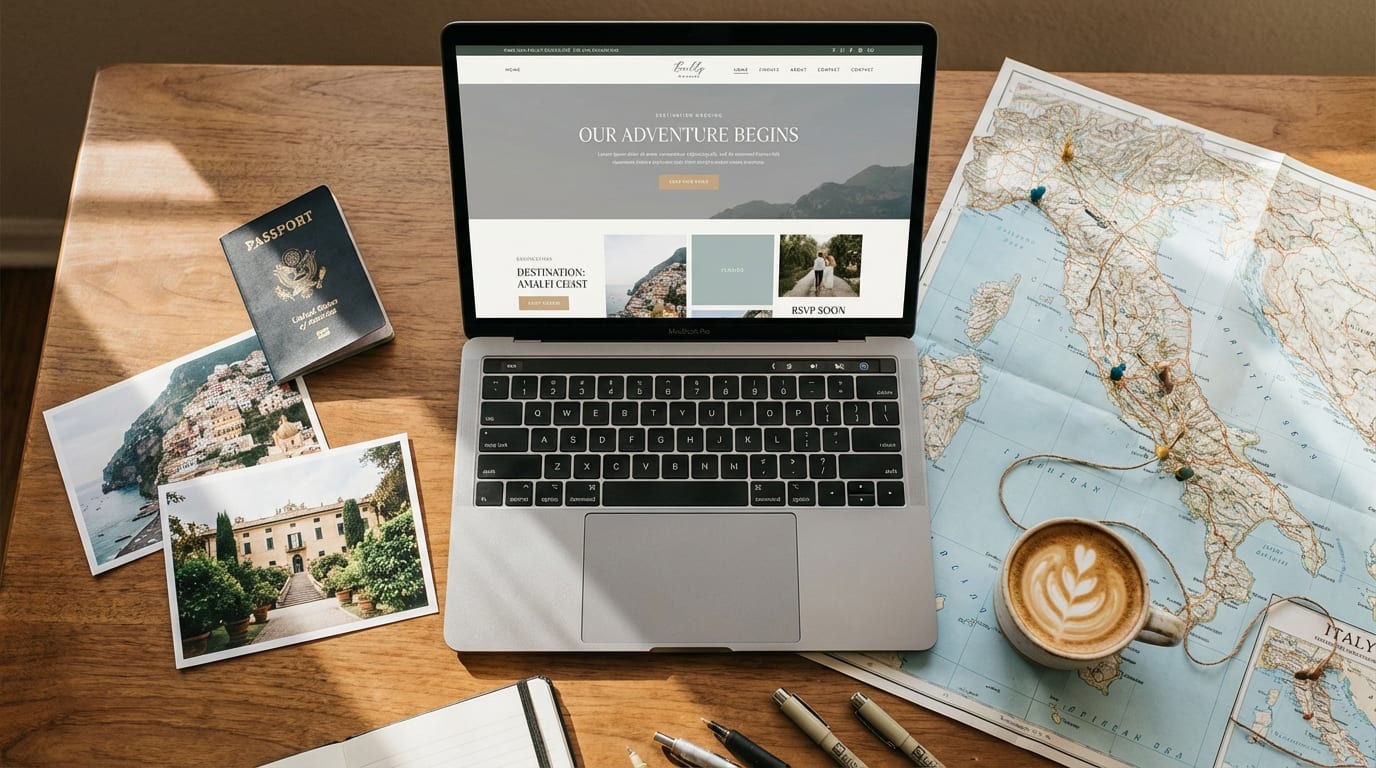
Destination wedding websites, as Riley & Grey notes, should include dedicated sections for travel logistics that local sites never need. Sites with detailed travel information and destination visuals can boost attendance by reducing the “unknown” factor that keeps guests on the fence, per TravelBash.
Your destination wedding website needs these pages that a local wedding site wouldn’t:
- Travel page: Nearest airport(s), recommended airlines, flight booking tips
- Accommodations page: Room block details with direct booking link, cutoff date in bold, alternative hotels at different price points
- Passport and visa info: Processing times, any vaccination requirements, a disclaimer to verify with the embassy
- Weather and packing guide: Average temperatures for your wedding month, rain likelihood, what to pack
- Full event schedule: Not just the ceremony, but the welcome dinner, pool day, group excursion, farewell brunch
- Local guide: Restaurants, beaches, activities for guests extending their trip
- FAQ page: Address the top 10 questions you keep getting (Is the water safe to drink? Do I need a rental car? What’s the Wi-Fi situation?)
Templates and Example Wording for Every Communication Type
Below are copy-and-customize templates for every major touchpoint. Adjust the destination, names, and dates to fit your wedding.
Save the Date (8-12 months out):
Save the Date! Emily Parker & David Nguyen are getting married in Punta Cana, Dominican Republic October 17, 2027
Invitation to follow. Start exploring travel details at emilyandavid.com
Formal Invitation Insert Card:
Travel Information
We’ve reserved a room block at the Secrets Royal Beach Punta Cana at a special group rate of $289/night (all-inclusive). Book by July 15, 2027 to guarantee availability: [booking link]
Fly into Punta Cana International Airport (PUJ). Round-trip shuttle service from the airport to the resort will be provided for all guests.
A valid passport is required for travel to the Dominican Republic. Please ensure yours is valid for at least six months beyond October 2027. Consult the Dominican Republic embassy to confirm current entry requirements.
RSVP Follow-Up (1 week after deadline):
Hey [Name]! Just checking in on your RSVP for our wedding in Punta Cana. We need to finalize our headcount with the resort by [date]. Could you let us know by [date] if you’ll be joining us? No pressure either way. We just want to make sure we have everything set for the guests who are coming. Here’s the RSVP link if you need it: [link]
Welcome Letter Opening:
Welcome to Punta Cana!
You made it, and we couldn’t be happier. Here’s your guide to the weekend:
Friday, Oct 15: Welcome cocktails at the pool bar, 7 PM (casual, come as you are) Saturday, Oct 16: Free day! Snorkeling trip at 10 AM for anyone interested (sign up at the front desk) Sunday, Oct 17: The big day! Ceremony at 4:30 PM on the beach, reception at 6 PM in the garden pavilion Monday, Oct 18: Farewell brunch at Seaside Cafe, 9 AM
Not-Invited Announcement (phone script):
“Hey [Name], I wanted to tell you personally that David and I are getting married in Punta Cana in October. We’re keeping it really small because of the venue, just immediate family and a handful of friends. We’d love to celebrate with you when we’re back. We’re planning a party in November. I didn’t want you to find out through Instagram.”
For a complete beach wedding checklist that maps every communication to your planning timeline, check out our month-by-month guide.
How BeachBride Can Help You Plan Every Detail
Planning guest communication for a destination wedding is one piece of a much bigger puzzle. Between negotiating room blocks, coordinating with international vendors, and keeping 60+ guests informed and excited, there’s a lot to manage.
That’s exactly what we built BeachBride to help with. Whether you’re just starting to explore destinations or you’ve already booked your venue and need help with the details, our tools and destination wedding tips are designed for couples planning from a distance.
Not sure where to start? Our free quiz matches you with destinations, resorts, and local planners based on your budget, guest count, vibe, and travel preferences. It takes about three minutes, and you’ll walk away with a personalized starting point instead of 47 open browser tabs.
Take the BeachBride quiz and get your personalized destination match