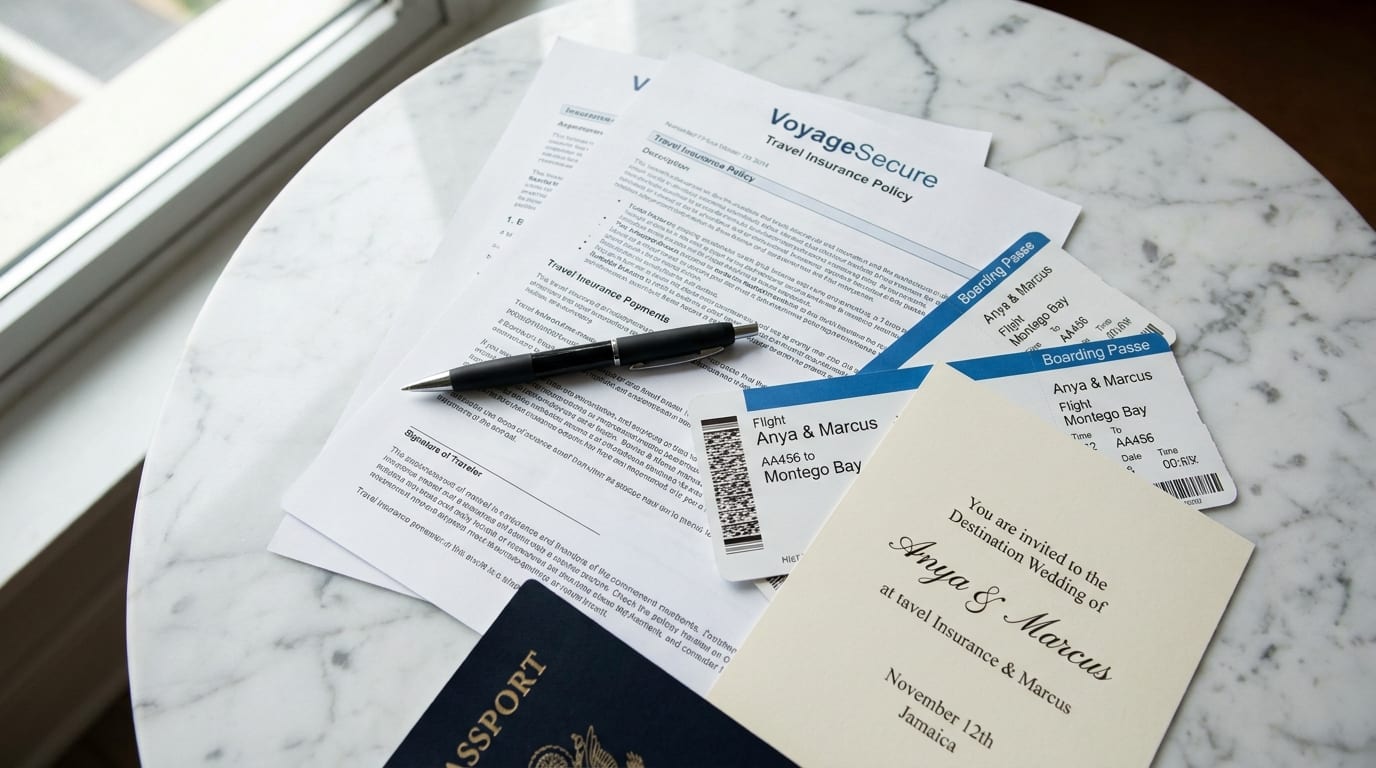
You’ve booked the flights. You’ve put down the resort deposit. Your destination wedding guide spreadsheet is filling up nicely. But here’s the question that trips up nearly every couple planning a wedding abroad: what happens if something goes wrong before you ever say “I do”?
Destination wedding travel insurance exists to answer that question. It protects the trip portion of your celebration: the flights, the hotel nights, the medical emergencies that can happen thousands of miles from home. But it does not protect the wedding itself. That distinction catches couples off guard constantly, and understanding it early can save you thousands of dollars and enormous stress.
What Is Destination Wedding Travel Insurance (and Why Is It Different From Regular Travel Coverage)?
It’s travel insurance tailored to the higher stakes and longer planning timelines of a wedding trip abroad. Standard travel insurance covers basics like medical emergencies, lost luggage, and flight delays for any vacation. Destination wedding travel insurance layers on protections for the unique risks couples face: coverage for ceremonial items like dresses and rings during transit, reimbursement windows aligned with wedding deposit schedules, and options for pre-existing condition waivers that matter when elderly relatives are flying internationally.
The key difference? Regular travel insurance treats your trip like any other vacation. It doesn’t account for the fact that you’ve spent months coordinating vendors, that your wedding dress is in a garment bag in the overhead bin, or that a hurricane forecast could upend plans you’ve been building for a year.
Trip cancellations account for roughly 25% of all travel insurance claims, with an average payout around $5,000. When your trip involves a wedding with $10,000+ in prepaid, non-refundable expenses, that baseline coverage becomes even more critical.
Travel Insurance vs. Wedding Event Insurance: Why You Probably Need Both
These are two completely different products that protect two completely different things. You likely need both for a destination wedding, and confusing them is the most expensive mistake couples make.
Travel insurance covers the journey: trip cancellation or interruption, flight delays, lost baggage, emergency medical care abroad, and evacuation. If a hurricane grounds your flight and you never make it to your Cancun destination wedding, travel insurance reimburses your prepaid travel costs.
Wedding event insurance covers the celebration: vendor no-shows, venue damage, liability if a guest gets injured at the reception, and postponement due to illness or extreme weather. If your caterer goes bankrupt the week before your ceremony, wedding event insurance covers the lost deposit.
Here’s where it gets tricky. Travel insurance will not reimburse you for a vendor failure. And wedding event insurance will not cover your guests’ flights home if a storm shuts down the airport. You need both policies working in tandem.
| Protection | Travel Insurance | Wedding Event Insurance |
|---|---|---|
| Flight cancellation/delays | ✓ | ✗ |
| Lost luggage (personal items) | ✓ | ✗ |
| Medical emergencies abroad | ✓ | ✗ |
| Emergency evacuation | ✓ | ✗ |
| Vendor no-show or bankruptcy | ✗ | ✓ |
| Venue damage or closure | ✗ | ✓ |
| Liability (guest injury at event) | ✗ | ✓ |
| Wedding postponement | ✗ | ✓ |
| Ceremonial attire lost in transit | Partial (as luggage) | ✓ (as wedding item) |
Wedding event liability coverage starts around $160 with no deductible under policies like the Travelers Wedding Protector Plan, and many venues now require it. Liability limits in wedding insurance often exceed $1 million, surpassing typical homeowners’ policies capped at $500,000.
What Does Travel Insurance Actually Cover for a Destination Wedding?
The core protections you’re paying for fall into a few clear categories. Here’s what standard travel insurance handles, and what falls outside its scope.
Covered under most travel insurance policies:
- Trip cancellation or interruption due to illness, injury, or death in the family
- Flight delays and missed connections
- Lost, stolen, or delayed baggage
- Emergency medical treatment abroad
- Emergency medical evacuation and repatriation
- 24/7 travel assistance hotline
Not covered (requires separate wedding event insurance):
- Vendor failures or lost deposits for caterers, photographers, or officiants
- Ceremony postponement due to weather (unless it prevents travel entirely)
- Damaged or stolen wedding attire at the venue
- Guest injuries at the reception
- Cold feet or change of heart
One critical nuance: if a hurricane prevents you from traveling to your destination, travel insurance covers your trip costs. But if you arrive and the hurricane forces a ceremony postponement while you’re already there, that’s a wedding event insurance claim. The line between “trip disruption” and “event disruption” matters enormously.
Policies may also deny claims for travel to destinations under government-issued advisories, so check the US State Department’s current advisory level for your destination before purchasing.
What Factors Affect How Much You’ll Pay?
Your premium depends on five main variables, and understanding them helps you budget accurately within your overall destination wedding cost.
Trip cost is the biggest driver. Travel insurance typically runs 4% to 8% of your total insured trip cost. A $3,000 trip means $120 to $240 in premiums. A $10,000 trip means $400 to $800.
Trip duration matters. Trips longer than one month increase premiums because you’re exposed to risk for a longer period.
Your destination’s risk profile. Countries with political instability, security threats, or active travel advisories cost more to insure. Stable, popular wedding destinations like Hawaii or Jamaica typically carry lower premiums than higher-risk regions.
Coverage level. A basic medical-only policy costs far less than one bundling trip cancellation, interruption, delays, baggage, and evacuation.
Pre-existing conditions and activities. Travelers with conditions like diabetes or heart disease pay more. Planning adventure activities like scuba diving or zip-lining? That increases your premium too.
Costs vary significantly based on season, guest count, and specific vendors. The percentages above are industry benchmarks, not guarantees.
Trip Protection for Your Wedding Party
Cover flights, hotels, and medical emergencies for your entire guest list. Cancel-for-any-reason options ideal for destination weddings.
A+ rated insurer. Group plans available for wedding parties.
Compare PlansIs CFAR Worth the Extra Cost for Destination Wedding Couples?
For most destination wedding couples, yes. CFAR (Cancel For Any Reason) is the upgrade that lets you walk away from a trip for literally any reason and still recover a portion of your costs.
Standard trip cancellation only covers specific “named perils”: illness, injury, death in the family, jury duty, military deployment. If your reason doesn’t appear on the list, you get nothing back. CFAR removes that limitation.
The tradeoff: CFAR adds 40-50% to your base premium and typically reimburses 50-75% of non-refundable trip costs rather than the full amount. For a couple with $8,000 in prepaid travel, a standard policy might cost $400. Adding CFAR brings that to roughly $560-$600. If you end up canceling, you’d recover $4,000-$6,000 instead of zero.
Why it matters specifically for weddings: destination weddings involve coordination across dozens of people. A family emergency, a falling-out with the wedding party, a sudden job loss, or even a global event that makes travel uncomfortable (but doesn’t trigger a government advisory) can all derail plans. Standard policies won’t cover those scenarios. CFAR will.
The catch: You must purchase CFAR within 10-21 days of your first trip deposit depending on the insurer. Miss that window and the option disappears entirely, no matter how much you’re willing to pay.
Why Medical Evacuation Coverage Is Non-Negotiable for Mexico and the Caribbean
This is the single most important line item for couples planning weddings in Punta Cana, Riviera Maya, Tulum, Jamaica, or anywhere else in the region. Here’s why.
US health insurance and Medicare do not cover medical care in Mexico or the Caribbean. Full stop. Private hospitals in tourist areas charge US-comparable rates and demand upfront cash payment. If you break a leg at your rehearsal dinner in Cancun, you’re paying out of pocket unless you have travel medical insurance.
But the real financial catastrophe is evacuation. An air ambulance from Mexico’s resort corridors to a US hospital costs $50,000 to $100,000. Caribbean evacuations for serious illness or injury, including transport between islands or repatriation home, can cost tens of thousands of dollars given many islands’ limited medical infrastructure.
Look for plans offering at least $500,000 in medical evacuation coverage. That sounds like a lot, but when you factor in air ambulance costs, ICU transfers, and family travel arrangements, it’s the minimum threshold recommended by industry experts for Mexico and Caribbean travel.
This applies to your guests too. Make sure your guest communication includes a clear recommendation that everyone purchase their own travel insurance with medical evacuation coverage.
When Should You Buy? (The Timing Window That Changes Everything)
Buy within 14 days of making your first trip deposit. That’s the window that unlocks everything.
This 14-day window matters because it qualifies you for pre-existing medical condition waivers (critical if parents or grandparents are traveling), CFAR eligibility, and maximum coverage duration. Travelers purchase insurance an average of 67 days before departure, but that’s too late for the best benefits.
Here’s the timeline that works for destination wedding couples:
- Day 1: Make your first trip deposit (flight, resort, or venue)
- Days 1-14: Purchase travel insurance with CFAR and pre-existing condition waiver
- Ongoing: Add coverage for additional trip costs as you book them (most policies allow this)
- 14+ days before wedding: Purchase wedding event insurance for extreme weather coverage eligibility
You can technically buy travel insurance up until 11:59 PM the day before departure. But buying late means losing CFAR eligibility, pre-existing condition coverage, and protection against events that become “foreseeable” between your booking date and purchase date.
Coverage begins at 12:00 AM the day after purchase. The earlier you buy, the longer you’re protected.
Trip Protection for Your Wedding Party
Cover flights, hotels, and medical emergencies for your entire guest list. Cancel-for-any-reason options ideal for destination weddings.
A+ rated insurer. Group plans available for wedding parties.
Compare PlansWhat About Your Guests - Can You Add Them to Your Policy?
No. Each guest needs their own individual policy. You cannot add wedding guests to your travel insurance after the fact, and policies limit coverage to named insureds only.
This surprises many couples, but the logic is straightforward: travel insurance is priced based on individual trip costs, health profiles, and ages. Your 28-year-old college friend and your 72-year-old grandmother present very different risk profiles to an insurer.
What you can do:
- Share a provider link. Send your guests a direct link to the same insurer you used so everyone has compatible coverage and a familiar claims process.
- Include it in your wedding website. Add a dedicated insurance section to your destination wedding website explaining why it matters and linking to a recommended provider.
- Mention it in save-the-dates. Your beach wedding checklist should include a guest communication touchpoint specifically about insurance, ideally 6+ months before the wedding.
Guests spend an average of $400 to attend destination weddings at popular US spots, with international trips costing significantly more. A travel insurance policy at 4-8% of that cost is a small price for protection against losing the entire investment.
Some insurers offer group plans designed for wedding parties, which can simplify the process even though each person is still individually covered.
Destination-by-Destination Insurance Considerations
Insurance needs shift depending on where you’re getting married. Here’s what to prioritize by region:
Mexico (Cancun, Tulum, Riviera Maya, Los Cabos): Medical evacuation is your top priority. US health insurance won’t help you here. Hurricane season runs June through November, so couples marrying during those months should strongly consider CFAR coverage purchased within the eligibility window. Check current US State Department advisories for your specific region, as some areas carry higher advisory levels than others.
Caribbean (Jamaica, Punta Cana, St. Lucia, Turks and Caicos): Similar to Mexico: medical evacuation is essential given limited hospital infrastructure on many islands. Caribbean evacuations often require inter-island transport before a mainland flight, adding complexity and cost. Hurricane season applies here too.
Hawaii: US health insurance works here since it’s domestic, so medical evacuation is less critical. Focus on trip cancellation and interruption coverage, especially during winter months when Pacific storms can disrupt flights.
Europe (Bali, Amalfi Coast, Santorini): Longer flights mean more connection points and higher rebooking costs if something goes wrong. Trip interruption coverage becomes more valuable. Some European venues require proof of event liability insurance before confirming your booking.
Costa Rica: Medical facilities in tourist areas are decent, but rural or beach locations may require evacuation to San Jose. Rainy season (May-November) overlaps with popular wedding months, making weather-related coverage important.
Insurance requirements and medical infrastructure change. Consult your local planner or the relevant country’s embassy to confirm current requirements before purchasing.
How to Get Coverage Through Our Approved Partner
We recommend Generali Travel Insurance for destination wedding couples. They hold an A+ rating from AM Best (the gold standard for insurer financial strength), offer group plans built for wedding parties, and provide CFAR upgrades within the 14-day purchase window that destination weddings demand.
Here’s how to get started:
- Gather your trip details: Total prepaid costs per person, travel dates, destination, and ages of all travelers
- Get a quote: Visit our partner page to compare plan levels and see exact pricing for your trip profile
- Choose your coverage level: Decide whether you want standard trip cancellation or the CFAR upgrade (remember: you need to purchase within 14 days of your first deposit for CFAR eligibility)
- Share with your guests: Send the same link to your wedding party so they can purchase individual policies with compatible coverage
For couples still in the early planning stages, our destination wedding budget hacks guide covers how insurance fits into your overall spending plan. And if you’re comparing all-inclusive resort packages, check what cancellation policies the resort offers before deciding how much trip cancellation coverage you need from your insurer.
Trip Protection for Your Wedding Party
Cover flights, hotels, and medical emergencies for your entire guest list. Cancel-for-any-reason options ideal for destination weddings.
A+ rated insurer. Group plans available for wedding parties.
Compare PlansReady to figure out which destination fits your vision (and your budget)? Take our free destination wedding quiz and we’ll match you with venues, planners, and resources tailored to your style, guest count, and timeline. Insurance is one piece of the puzzle. Let us help you see the full picture.