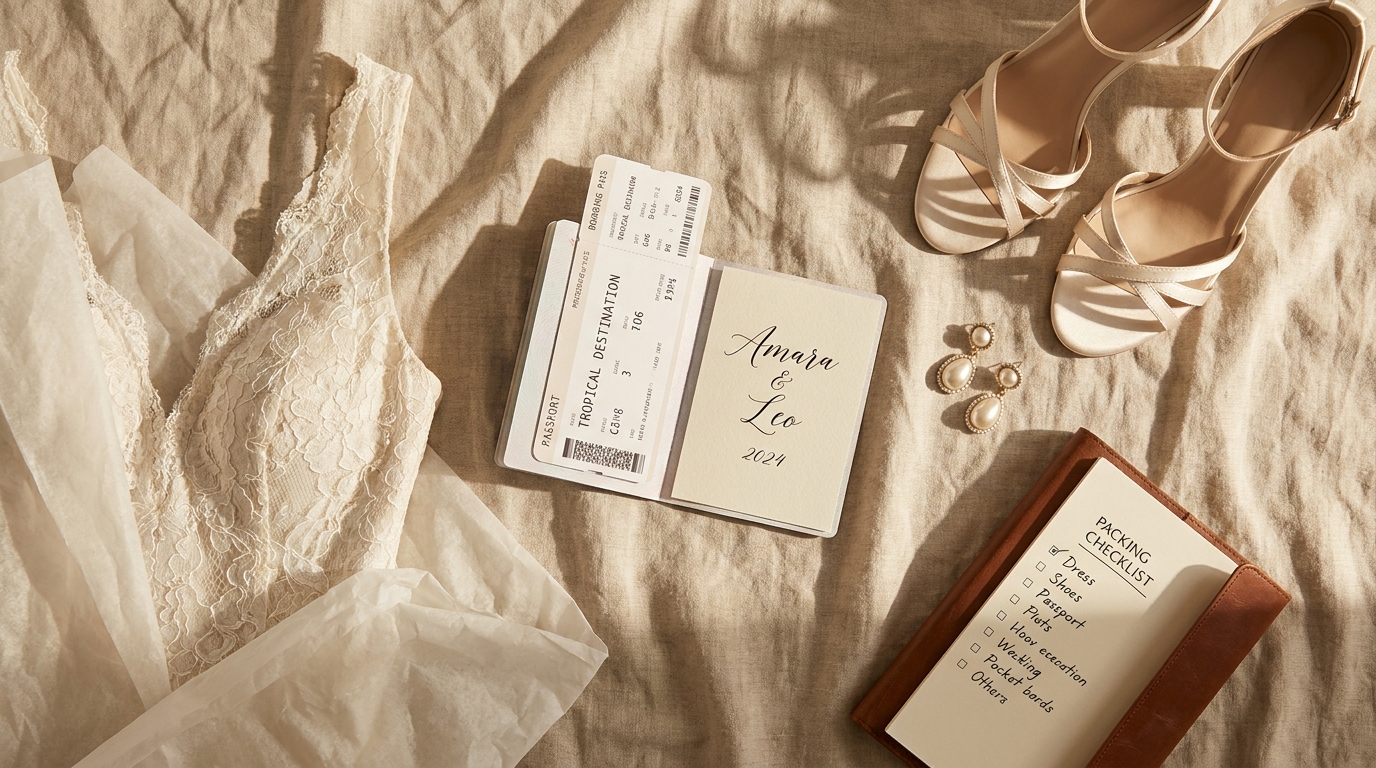
You’re not just packing for a trip. You’re packing for a multi-day celebration where you’re simultaneously the guest of honor, the host, and a traveler hauling irreplaceable items across time zones. A solid packing checklist for your destination wedding is the difference between a relaxed arrival and a frantic scramble through unfamiliar shops looking for fashion tape at midnight.
Roughly 17% of all global weddings are now destination weddings, as Radical Storage notes. That’s millions of couples every year figuring out how to fit a ceremony, a reception wardrobe, legal documents, and a honeymoon into airline-approved luggage. This guide walks you through every step, so nothing gets left behind.
If you’re still in the early stages, our destination wedding guide covers the full planning timeline. But right now? Let’s pack.
Why Packing for a Destination Wedding Is Nothing Like Packing for a Vacation
A vacation forgives mistakes. Forgot your sunglasses? Buy new ones at the airport. A destination wedding does not offer that same flexibility.
The average destination wedding covers about 50 guests across multiple structured events, welcome party, rehearsal dinner, ceremony, reception, and sometimes a farewell brunch, as Paradise Weddings notes. That’s 4 to 5 nights of outfit changes, not a single suitcase of swimwear and sandals. You need formal attire, backup options, legal paperwork, vendor coordination materials, and an emergency kit that would make a flight attendant proud.
The other critical difference? You can’t send someone home to grab what you forgot. You’re abroad, possibly in a location where specialty items aren’t available. Your veil, your cufflinks, your marriage license paperwork: if it’s not in your bag, it might not exist at your destination.
What Should You Gather Before You Start Packing?
Start your packing process 3 to 4 weeks before departure, not the night before your flight.
Pull together these categories first, then pack them in priority order:
- Legal documents (passports, birth certificates, marriage license paperwork)
- Wedding attire and accessories (dress, suit, shoes, jewelry, veil)
- Beauty and grooming supplies (travel-sized, TSA-compliant)
- Emergency kit (stain remover, first aid, fashion tape)
- Vendor packets (contracts, timelines, contact sheets)
- Tech and chargers (power bank, universal adapter, backup storage)
- Guest coordination items (welcome bag supplies, printed itineraries)
As WeddingWire notes, carry-on liquids must be 100 ml or less per container, sealed in a single quart-sized clear bag. That rule shapes your entire beauty and skincare strategy, so plan around it early.
Check your beach wedding checklist for a broader planning timeline, then use the steps below to build your packing list.
Step 1: What Wedding Documents and Legal Paperwork Do You Need to Bring?
Every destination has its own legal requirements, and missing a single document can delay or prevent your ceremony entirely.
All Inclusive Weddings notes that popular Caribbean destinations each have specific rules. Here’s a quick comparison:
| Destination | Residency Period | Key Document Requirements | Special Notes |
|---|---|---|---|
| Jamaica | 48 hours (incl. weekends) | Passports, notarized copies of IDs | Copies must be mailed to provider’s office in advance |
| Aruba | 48 hours (business days only) | Passports, state-issued birth certificates | Originals with certified court seals required |
| Grenada | 72 hours (incl. weekends) | Passports, birth certificates, notarized copies | Late submissions incur a US$150 fee |
| Mexico | Varies by state | Passports, blood tests (some states), birth certificates | Legal marriage in Mexico has its own detailed process |
Many countries require passports valid for at least 6 months beyond your ceremony date, as Here Comes the Guide notes. If you’ve been divorced, bring every page of your court-certified final judgment. If you’ve changed your name, bring the legal documentation.
Your document packing rule: Originals go in your carry-on. Digital copies go on your phone and in the cloud. Photocopies go in your partner’s carry-on. Never check irreplaceable paperwork.
Legal requirements change frequently, so consult your local planner or the country’s embassy to confirm current requirements before you fly.
Step 2: How Do You Pack Your Wedding Dress (Without Ruining It)?
Your dress travels in your carry-on, on your lap if necessary, but never in checked luggage.
Azazie recommends using 3 to 4 sheets of acid-free tissue paper at each fold to cushion creases. Fold skirts in thirds lengthwise (quarters for ball gowns), with tissue between every layer. The first fold should happen at the natural waist, and the final fold brings the hem toward the bodice.
Here’s what the pros do:
- Stuff the bodice with crumpled tissue to hold its shape.
- Skip the plastic dry-cleaning bag. Plastic traps moisture and creates a mildew-prone environment, as La Mer Dry Cleaners notes. Use a breathable fabric garment bag instead.
- Ask the flight crew if they can hang your dress in the crew closet. Most airlines accommodate this request when you ask politely at the gate.
- Bring a portable steamer to release any wrinkles after arrival. A compact travel steamer weighs under a pound and fits in your checked bag.
For suits and formalwear, the same principles apply: tissue paper at the folds, breathable bag, carry-on whenever possible. Check out our guide to beach bride accessories for lightweight pieces that pack flat and look stunning in photos.
Step 3: What Beauty, Hair, and Skincare Essentials Should You Pack?
Solid products are your best friend for destination wedding travel.
Solid face washes and shampoos last 3 to 4 times longer than their liquid counterparts, as Bridal Musings notes. They also eliminate the risk of spills and free up precious space in your TSA quart bag.
For liquids you can’t replace with solids (think setting spray, liquid foundation, sunscreen), transfer them into travel-sized containers under 3.4 oz. According to professional makeup artist Ana B., double-bagging liquids in ziploc pouches can reduce your kit weight by up to 50%.
Your beauty packing list should include:
- Solid shampoo and conditioner bars
- Travel-sized setting spray and foundation
- Waterproof mascara and eyeliner (essential for beach ceremonies)
- Dry shampoo (a lifesaver in humidity)
- Reef-safe sunscreen (SPF 30 minimum)
- Your own hair dryer, curling iron, or flat iron (only about 40% of resorts stock styling tools)
- Bobby pins, hair ties, and a detangling brush
Climate matters here. Bali’s humidity will melt a matte foundation in minutes, while Santorini’s dry heat calls for heavier moisturizer. Research your destination’s weather patterns and adjust your products accordingly. Our destination wedding tips page has climate-specific advice for the most popular locations.
Step 4: What Wedding Day Emergency Kit Items Should Every Couple Have?
A small zippered pouch with the right 15 items will save you from 90% of wedding day surprises.
Elle and Stuart report that 1 in 5 wedding guests accidentally spills a drink during the reception, and 30% of outdoor wedding guests report being bothered by insects. Your emergency kit needs to handle both.
Pack these in a single, clearly labeled bag:
- Stain remover pen or stick
- Fashion tape (double-sided)
- Safety pins (assorted sizes)
- Mini sewing kit with white, black, and ivory thread
- Clear bandages and blister pads
- Pain relievers (ibuprofen and acetaminophen)
- Allergy medication (antihistamines)
- SPF 30+ sunscreen
- Bug spray (DEET-based for tropical locations)
- Breath mints
- Eye drops
- Nail file and clear nail polish for runs in stockings
- Tissues
- Phone charger and portable power bank
- Printed copy of your vows
A compact first aid kit with 18+ bandages, sanitizer, and antibiotic ointment is standard for any wedding, as The Knot notes. Don’t assume your venue or planner will provide one. Most don’t.
Assign this kit to a trusted member of your wedding party. You shouldn’t be the one carrying it on the big day.
Step 5: What Should Your Guests Know to Pack?
Your guests need a packing guide, and the best place to share it is your destination wedding website.
The Knot reports that 70% of destination wedding guests pack multiple outfits for the multi-event weekend. But many still forget essentials like prescription medications, power adapters, or weather-appropriate layers.
Include these details in your guest communication:
- Dress code for each event (ceremony, reception, welcome party, brunch)
- Expected weather and temperature ranges
- Whether the venue is on sand, grass, or hard flooring (this changes shoe choices entirely; point them to our beach bridal shoes guide for ideas)
- Reminder to bring reef-safe sunscreen and bug spray
- Note about power adapters if traveling internationally
- Suggestion to pack a light layer for air-conditioned venues or evening breezes
Keep it simple. A short, friendly list on your wedding website works better than a 3-page PDF nobody reads.
Step 6: How Do You Handle Vendor Coordination Items and Décor You’re Bringing?
Ship heavy or fragile items ahead of time, and carry only what’s lightweight and irreplaceable.
Junebug Weddings notes that a significant majority of destination wedding couples transport at least some personal décor. The question is how.
Ship ahead (via UPS, DHL, or FedEx):
- Centerpiece elements, vases, or candle holders
- Guest book and card box
- Welcome bag supplies (snacks, maps, itineraries)
- Signage and frames
Carry in your luggage:
- Table numbers and flat paper goods
- Ribbon, fabric swatches, or small textile elements
- Cake topper
- Printed timelines and vendor contact sheets
Leave at home (source locally instead):
- Fresh flowers (many destinations restrict agricultural imports)
- Bulky arch structures (your local florist or planner can provide these)
- Anything over 50 lbs that would trigger excess baggage fees
One important note: if you’re bringing items into countries like Mexico or Jamaica, you may need to declare wedding décor at customs. Items under $800 total value per person are typically duty-free for U.S. travelers, but fresh flowers face inspection and possible confiscation. Costs vary significantly based on season, guest count, and specific vendors, so get quotes from local suppliers before deciding to ship from home.
Step 7: What Tech, Chargers, and Backup Gear Should Make the Cut?
A dead phone battery at the altar is preventable. So is a lost memory card full of ceremony photos.
Neurapix notes that destination weddings generate enough photo and video data to require at least 128 to 256GB of storage per camera per day. Even if you’ve hired a professional photographer, you’ll want your own devices charged and ready.
Your tech packing list:
- Portable power bank (10,000 to 20,000mAh with USB-C)
- Universal power adapter (verify your destination’s plug type and voltage)
- At least 2 charging cables per device
- A compact travel power strip for hotel rooms with limited outlets
- Extra memory cards if you’re shooting personal video
- Bluetooth speaker for getting-ready playlists (small, waterproof)
Airlines require lithium-ion batteries in carry-on luggage only, with terminals taped over. Never pack batteries in checked bags. This is a safety regulation, not a suggestion.
If you’re hiring a destination wedding planner, they can often arrange backup tech on-site. But your personal devices? Those are on you.
Common Packing Mistakes Couples Make (And How to Avoid Them)
Even organized couples fall into these traps. Here are the ones we see most often:
Overpacking “just in case” outfits. You don’t need a backup for every event. Overpacking is one of the top reasons couples incur excess baggage fees, as Château Saint Georges notes. Pick versatile pieces that work across multiple events.
Checking irreplaceable items. Your dress, rings, documents, and medications belong in your carry-on. Period. Checked bags get lost, delayed, and sometimes damaged. If you can’t replace it at your destination, it flies with you.
Ignoring the weather forecast until the last minute. A beach in Costa Rica in September is very different from a beach in Santorini in June. Pack layers. Pack a light rain jacket. Don’t trust a 10-day forecast from your couch.
Skipping travel insurance. Flights alone run an average of $500 to $600 per person, as Paradise Weddings notes. A single cancellation or lost bag can cost thousands. Travel insurance is not optional for a destination wedding. (Costs vary significantly based on season, guest count, and specific vendors.)
Trip Protection for Your Wedding Party
Cover flights, hotels, and medical emergencies for your entire guest list. Cancel-for-any-reason options ideal for destination weddings.
A+ rated insurer. Group plans available for wedding parties.
Compare PlansForgetting to brief your wedding party. Your bridesmaids and groomsmen need to know what to bring too. Share your packing list with them, especially the emergency kit items and dress code details.
When Should You Let Your Local Planner Handle the Logistics Instead?
A local planner becomes essential when the logistics of what to source, ship, and set up exceed what you can reasonably manage from another country.
Local planners, as Flawless Weddings and Events VI notes, handle unpredictable factors like delivery windows, site access restrictions, tide schedules, and vendor availability that remote planning simply can’t account for. They know which flowers are available locally (so you don’t ship them), which rental companies are reliable, and which permits you actually need.
As Destination I Do notes, booking a planner 12 to 16 months out gives you the best vendor availability and the most realistic timeline for permits and legal paperwork.
Let your planner handle:
- Sourcing florals, linens, and large décor locally
- Coordinating delivery and setup at the venue
- Managing legal paperwork submissions and residency requirements
- Arranging backup plans for weather
You handle:
- Packing your personal attire and accessories
- Carrying legal document originals
- Bringing your emergency kit
- Packing sentimental items (vow books, family heirlooms, a specific cake topper)
Browse local wedding planners at your destination, or check our curated lists for popular spots like Cancun, Hawaii, Jamaica, and Bali.
You’ve got the checklist. You’ve got the strategy. Now the only question is: which destination is right for you? Take our free BeachBride quiz to get matched with venues, planners, and vendors who fit your style, your budget, and your vision. It takes about two minutes, and it might be the most useful two minutes of your entire planning process.